
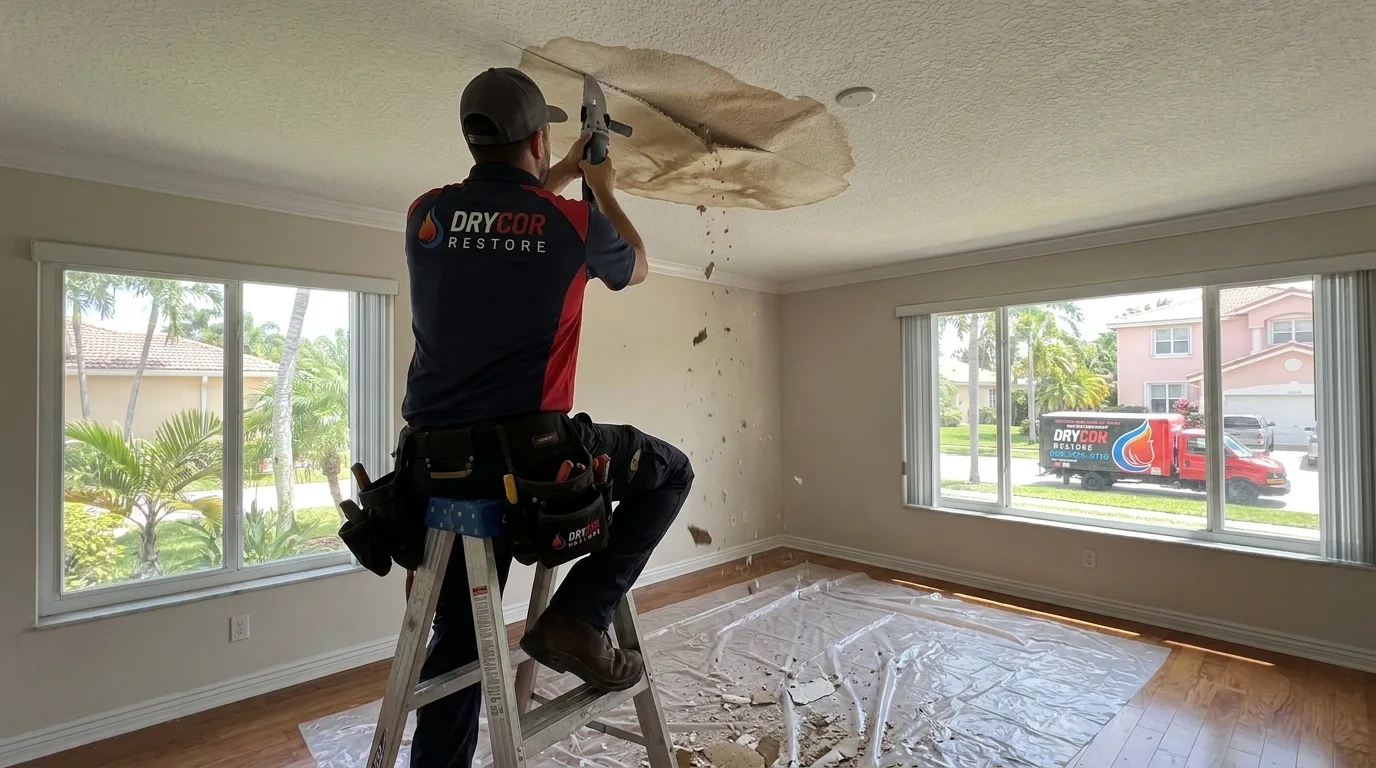
24/7 Emergency Ceiling Water Damage Repair in Thonotosassa
24/7 emergency ceiling water damage repair in Thonotosassa and surrounding areas. IICRC-certified, insurance billing accepted. Call (813) 829-1091.
Ceiling leaking or showing a spreading water stain in Thonotosassa? We answer 24/7, and the sooner we get a moisture meter on that cavity, the better the odds of saving the drywall instead of replacing it. A yellow-brown ring on a ceiling rarely stays the size it started. Left alone, trapped water keeps migrating along joists and lath, softening paper facing and plaster keys until a section lets go, usually at the worst possible hour. Ceiling water damage repair is its own discipline because gravity, not just moisture, is working against the structure above your head.
What Ceiling Water Damage Repair actually involves
A leaking ceiling is almost never just a cosmetic stain. Water that reaches drywall or plaster has usually already traveled through insulation, framing, or a finished attic space above it, and that hidden volume is what determines whether you’re looking at a patch job or a full cavity rebuild. Our crews use moisture meters and thermal imaging to trace the wet path back to its source, whether that’s a roof penetration, a failed wax ring on an upstairs toilet, a cracked supply line, or an AC condensate line that’s been dripping unnoticed for weeks. Depending on how saturated the insulation and framing are, drying a ceiling cavity can run anywhere from two to five days with air movers and dehumidifiers positioned above and below the affected plane, under moisture readings documented per the IICRC S500 standard.
Our process
- Source identification. We trace the leak to its actual origin before touching the ceiling. Patching drywall over an active source just delays the next collapse.
- Controlled drainage and demo. If water is pooling behind a sagging section, we create a deliberate weep point or remove material in a controlled way rather than letting gravity choose where it fails.
- Cavity drying. Wet insulation is removed, framing and lath are dried in place with targeted air movement, and we log moisture content daily until readings match dry, unaffected areas of the home.
- Repair and texture match. New drywall or plaster is set, taped, and finished to match existing texture, whether that’s smooth, knockdown, or popcorn, before priming and paint.
- Final moisture verification. We confirm the cavity is back to baseline before closing anything up, so paint isn’t going over a surface that’s still drying from the inside.
What separates a good ceiling repair response from a bad one
The most common mistake is treating a ceiling stain as a surface problem and skipping the drying step entirely, patching and repainting over framing that’s still damp. That traps moisture against wood for weeks, which is exactly the window mold needs to establish in a dark, humid cavity. A second mistake is texture mismatch, repairing a popcorn or hand-troweled ceiling with a smooth patch that’s obvious from across the room. Insurance adjusters reviewing a ceiling claim typically want documented moisture readings, photos of the cavity before it’s closed up, and a clear explanation of the source, not just a repaired stain. We document all three as a matter of standard process.
What does Ceiling Water Damage Repair cost?
Every ceiling loss is different, and we provide a written scope before any work begins so you know what’s included and what isn’t. Homeowners insurance typically covers ceiling water damage repair when the cause is sudden and accidental, like a burst supply line, though gradual leaks from long-term neglect are often excluded, so documentation matters. Below are typical industry ranges, not a quote.
| Scenario | Typical range |
|---|---|
| Small stain, drywall intact, no drying needed | $300 - $800 |
| Drywall patch and repaint, single room | $600 - $1,500 |
| Plaster or textured ceiling repair with match | $900 - $2,200 |
| Sagging ceiling, insulation removal and replacement | $1,500 - $4,000 |
| Multi-room damage from a roof or attic leak | $3,000 - $8,000 |
Seasonal & regional considerations
Thonotosassa’s rainy season, roughly June through September, brings heavy afternoon thunderstorms that expose roof flashing issues and clogged gutters you might not notice the rest of the year. Hurricane season adds wind-driven rain that can force water under shingles and tile that otherwise shed water fine. Florida’s humidity also means AC condensate lines run constantly, and a clogged drain pan or line is one of the more overlooked causes of a slow ceiling stain in rooms below an attic air handler.
Service area
We repair ceiling water damage throughout Thonotosassa and surrounding communities including Tampa, Temple Terrace, Plant City, and Zephyrhills.
If water is coming through your ceiling or a stain is spreading, don’t wait for it to tell you where the weak point is. Schedule your ceiling moisture assessment and get a written scope before the drywall decides for you.
Services We Handle
- Ceiling Collapse Repairs
- Roof Leak Water Damage
- Roof Leak Water Damage Cleanup
Frequently Asked Questions
Does homeowners insurance cover ceiling water damage repair?
How do I know if a sagging ceiling is about to collapse?
Why does a ceiling water stain keep spreading even after the leak is fixed?
Do you have to cut open my whole ceiling to find the leak?
Can mold grow inside a ceiling cavity even if the drywall still looks dry on the surface?
Looking for the best ceiling water damage repair company in Thonotosassa?
DRYCOR RESTORE provides licensed and insured ceiling water damage repair in Thonotosassa, FL and the surrounding area, and has served local property owners since 2005. Customers rate us 5.0 out of 5 stars on Google. We answer calls 24/7 — call (813) 829-1091 for immediate help.
Need Ceiling Water Damage Repair now?
We respond 24/7 across Thonotosassa and surrounding FL cities.