
Water Damage Restoration in St. Pete Beach
24/7 water damage restoration in St. Pete Beach, FL. IICRC-certified, insurance billing accepted. Call (813) 829-1091.
Our IICRC-certified technicians are dispatched from our Thonotosassa, FL headquarters and are typically on-site in St. Pete Beach within 60 minutes of your call.
St. Pete Beach sits on a narrow barrier island where the Gulf of Mexico and Boca Ciega Bay compete for every inch of low-lying land. When a water heater fails, a storm surge creeps under a door, or a supply line lets go inside a concrete-block home built in the 1960s, the moisture has nowhere to drain and everything to saturate. DRYCOR RESTORE responds around the clock to water damage calls throughout St. Pete Beach, bringing IICRC-certified technicians and industrial drying equipment to a community where the combination of salt air, high humidity, and aging infrastructure makes fast action the difference between a repair and a rebuild.
Why St. Pete Beach Properties See Water Damage Differently Than Inland Homes
The barrier-island setting creates conditions that simply do not exist ten miles east on the mainland. The water table here sits close to the surface year-round, which means a slow leak under a slab does not just wet the concrete, it wicks upward into flooring and wall bases because there is no dry soil below to absorb the excess. Homes built along the Gulf-side streets and the bay-facing canals were largely constructed between the 1950s and 1970s using concrete block and terrazzo flooring, materials that handle coastal conditions well structurally but behave in specific ways when water intrudes. Terrazzo is dense and non-porous on the surface, but the sand-and-cement base beneath it holds moisture long after the visible puddle is gone, and standard moisture meters can give a false-dry reading if a technician does not probe the substrate.
Salt air accelerates corrosion on HVAC drain pans, copper supply lines, and water heater connections, making appliance-related leaks more common here than in drier inland markets. Tropical storm season, which runs well into November along this stretch of Pinellas County coastline, brings wind-driven rain that finds its way through aging window glazing and flat or low-slope roofs common on mid-century Florida construction. Once that water is inside a concrete-block wall cavity, it does not evaporate quickly because the block itself slows airflow.
Our Water Damage Restoration Process in St. Pete Beach
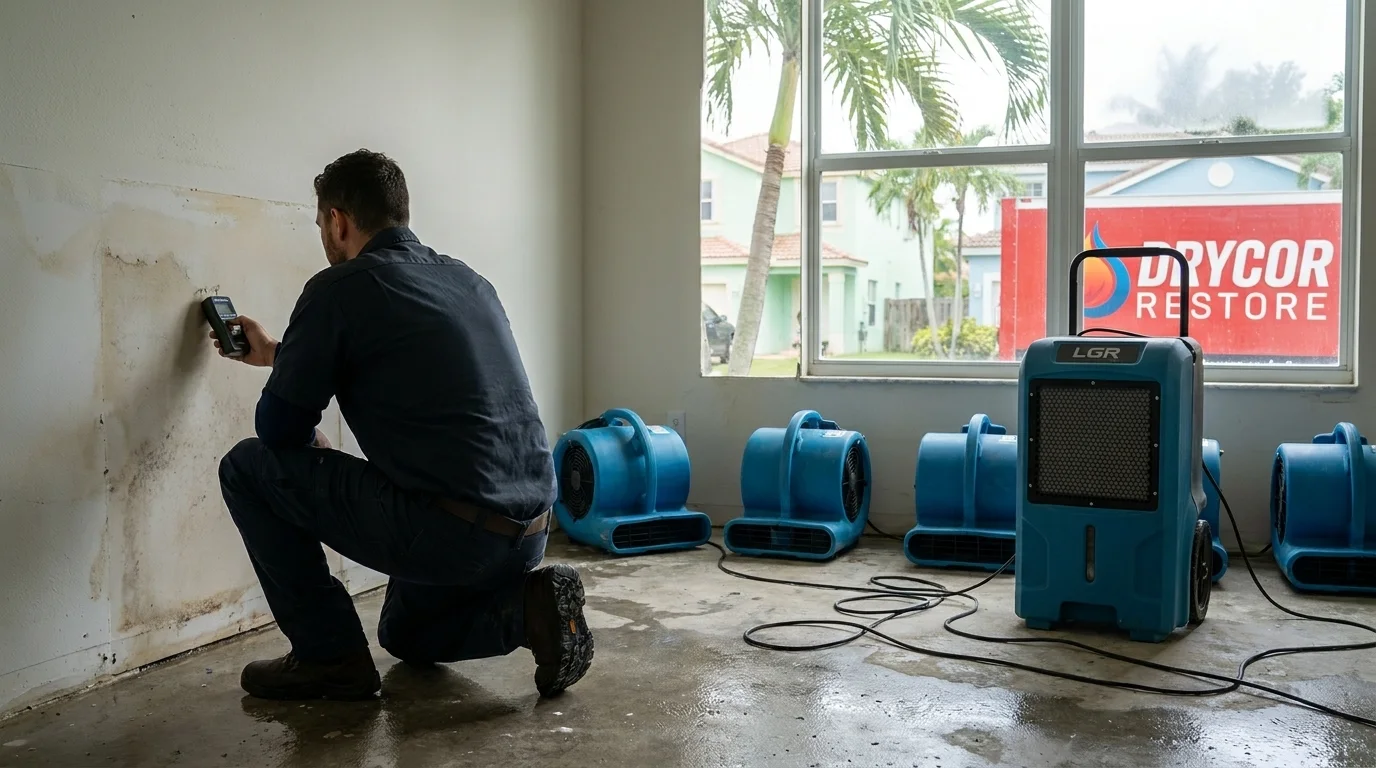
Every job starts with a thorough inspection using thermal imaging cameras and calibrated moisture meters. On barrier-island properties, that inspection always includes the slab perimeter and any areas where exterior grade sits at or near finished floor elevation, because those are the first places to show hidden saturation after a storm or a plumbing event.
After the scope is mapped, water removal comes first. Truck-mounted extraction pulls standing water from tile, terrazzo, and carpet far faster than portable units, and speed matters: in St. Pete Beach’s ambient humidity, secondary moisture migration into wall cavities and cabinetry begins within hours. Once bulk water is out, the crew sets drying equipment calibrated to the actual conditions, not a generic formula. Dehumidifiers are sized to the cubic footage and the measured grain depression needed to bring the space to a dry standard. Air movers are positioned to create directed airflow through wall cavities and under cabinetry rather than just across open floor space.
For homes with terrazzo floors or original plaster-over-block walls, drying timelines typically run longer than modern drywall construction, and monitoring visits are scheduled to verify that readings are trending correctly before equipment is removed. The goal is to meet the IICRC S500 drying standard, not simply to reach a point where the floor feels dry underfoot.
Reaching St. Pete Beach from Thonotosassa
DRYCOR RESTORE operates 24/7, and the route from the Thonotosassa area to St. Pete Beach runs west on I-4 to I-275 south, crossing the Howard Frankland Bridge into Pinellas County and continuing south toward the beaches. Because St. Pete Beach is accessed primarily via Gulf Boulevard and the Pinellas Bayway, traffic patterns and bridge access can affect staging, particularly during peak tourist season when Gulf Boulevard sees heavy congestion. When you call, the dispatch team accounts for current conditions and routes the nearest available crew. If you are on the bay-side streets near the Corey Avenue corridor or out toward the quieter residential blocks closer to Pass-a-Grille, let the dispatcher know your cross street so the crew can plan the most direct approach.
St. Pete Beach Insurance Coordination
Water damage claims on barrier-island properties sometimes draw additional scrutiny from carriers because of the overlap between storm-related and plumbing-related causes of loss. DRYCOR RESTORE documents the loss thoroughly from the first visit: moisture readings with timestamps, photographs of affected materials before any work begins, and a written scope that distinguishes the source and category of water. That documentation gives your adjuster a clear record and reduces the back-and-forth that can slow a claim. The crew also notes any pre-existing conditions separately so that unrelated prior damage does not complicate your claim.
Local Note
Homes on the canal-front streets between the bay and the interior of St. Pete Beach often have original 1960s-era jalousie windows that are no longer watertight during wind-driven rain. When water enters through those windows during a tropical system, it typically runs down the interior block wall inside the stucco, making the entry point invisible from inside the room. Technicians working in this housing stock check the base of every exterior wall with a pin meter, not just the area directly below the window, because the water travels laterally through the block mortar joints before it shows up at floor level. Missing that migration pattern is one of the most common reasons a St. Pete Beach home gets re-wet after a partial dry-out.
When water damage hits your St. Pete Beach property, the clock starts immediately. Call DRYCOR RESTORE at (813) 829-1091 any time, day or night, and a certified crew will be on the way to assess the loss, stop further damage, and start the drying process before the Gulf Coast humidity does more work than it already has.
Serving St. Pete Beach from our Thonotosassa headquarters — ★ 5.0 · 23 Google reviews
“The Showalter Construction and Restoration Team as well as DryCor Restore have been a Great Help and Excellent Experience. From Initial assessment, Insurance navigation, Expert Advice, Execution of Restore have been spot on ! The Crew of Victor, Victor, Damen and Garrett are the best, Hard working…” — Mark, June 2026Read our reviews on Google →
Water Damage Restoration in St. Pete Beach: Service Coverage
Frequently Asked Questions
How fast can you arrive for water damage restoration in St. Pete Beach?
How does St. Pete Beach's high water table affect a water damage restoration job?
Are the older concrete-block homes common in St. Pete Beach harder to dry out after a water loss?
Can you reach the Pass-a-Grille end of St. Pete Beach as quickly as the northern part of the city?
How does salt-air corrosion in St. Pete Beach affect water damage claims?
What does structural drying actually involve, and how long does it typically take in St. Pete Beach's climate?
Will my homeowners insurance cover water damage restoration in St. Pete Beach?
Water Damage Restoration response in St. Pete Beach
Most St. Pete Beach calls see a technician on-site within 60 minutes from our Thonotosassa headquarters.