
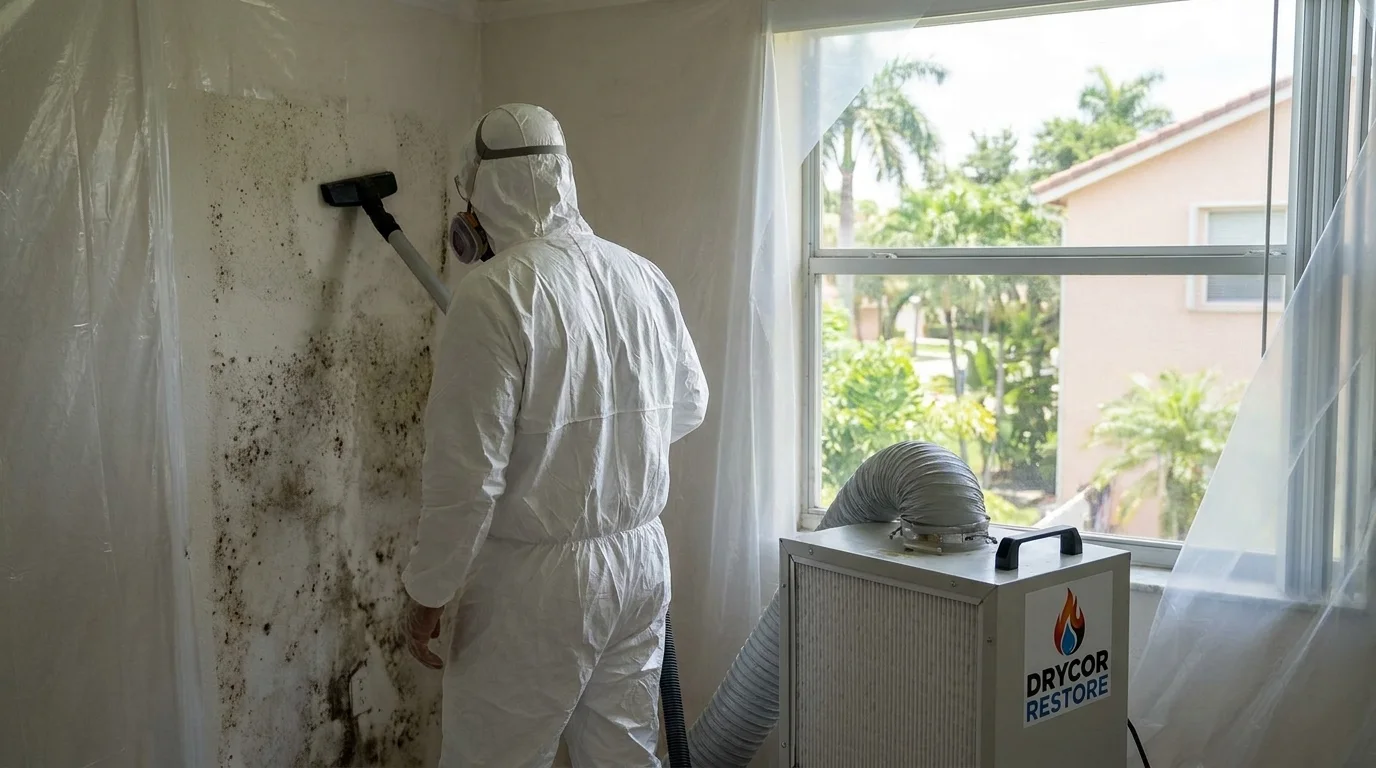
Mold Remediation in St. Pete Beach
24/7 mold remediation in St. Pete Beach, FL. IICRC-certified, insurance billing accepted. Call (813) 829-1091.
Our IICRC-certified technicians are dispatched from our Thonotosassa, FL headquarters and are typically on-site in St. Pete Beach within 60 minutes of your call.
St. Pete Beach sits on a narrow barrier island where the Gulf humidity rarely relents, and the gap between a slow roof leak and a full mold colony can be measured in days rather than weeks. Salt-laden air, year-round warmth, and the kind of crawl-space moisture that never fully dries out between rainstorms create conditions where mold doesn’t just appear after a flood, it develops quietly behind shower tile, inside wall cavities, and under the tongue-and-groove flooring common in the island’s older beach cottages. DRYCOR RESTORE responds to mold calls across St. Pete Beach around the clock, bringing IICRC-certified and NAERMC-credentialed technicians to properties where the environment itself works against a quick fix.
Why St. Pete Beach Properties See Mold Issues
Barrier island living comes with a specific set of building challenges that mainland Pinellas County properties don’t share in the same way. The water table here is extremely shallow, and slab-on-grade construction, standard for much of the residential stock built through the 1960s and 1970s, means there is very little buffer between the ground moisture and the interior of a home. When a supply line weeps slowly or a window seal fails during a tropical system, water doesn’t drain away; it migrates laterally through the slab and wicks upward into baseboards and drywall.
The Gulf-side exposure also means that even homes without an active leak carry elevated ambient humidity for most of the year. Air conditioning systems work hard here, and when they cycle off or a unit is undersized for the square footage, interior relative humidity can climb into the range where Cladosporium, Aspergillus, and other common mold species colonize porous materials within 48 to 72 hours. Older beach cottages throughout the city often have original wood framing that has absorbed decades of that humidity, making them more susceptible than newer concrete-block construction.
Our Mold Remediation Process in St. Pete Beach
Every mold remediation project starts with a thorough inspection rather than an assumption. Technicians use thermal imaging and moisture meters to map where water has traveled inside wall assemblies and under flooring, because in a coastal home, the visible staining on a surface is rarely the full picture. Once the scope is defined, containment goes up before any demolition begins: negative air pressure chambers with HEPA-filtered exhaust prevent spores from migrating to unaffected rooms while work is underway.
Demolition of unsalvageable materials is followed by HEPA vacuuming of all framing and substrate surfaces, then application of an EPA-registered antimicrobial treatment. Drying equipment, commercial dehumidifiers and air movers calibrated for the coastal humidity load, runs until moisture readings in the structural materials return to acceptable baselines. In St. Pete Beach’s climate, that drying phase often runs longer than it would for an inland property at the same square footage, because the outdoor dew point is working against the equipment continuously. Final air sampling by an independent industrial hygienist confirms clearance before containment comes down.
Reaching St. Pete Beach from Thonotosassa
DRYCOR RESTORE operates 24/7, and the route from Thonotosassa to St. Pete Beach runs west on I-4 to I-275 South, crossing the Howard Frankland Bridge and continuing down the Pinellas peninsula to the Corey Causeway or Gulf Boulevard, depending on the address. The barrier island’s single main corridor, Gulf Boulevard, is the primary north-south artery, and knowing which end of the island a property sits on affects staging. Homes near the southern end of the city require a different approach than those closer to the Treasure Island city line to the north, particularly for larger equipment trailers that cannot easily turn around on the narrow residential streets running perpendicular to the Gulf.
St. Pete Beach Insurance Coordination
Mold claims in Florida carry specific documentation requirements that differ from a straightforward water loss. Carriers typically want a clear chain of causation, proof that the mold resulted from a covered peril rather than long-term maintenance neglect. DRYCOR RESTORE photographs and documents the moisture source, the extent of affected materials, and the remediation scope in a format that aligns with what adjusters need to process the claim. For condo and townhome owners, the question of whether the loss falls under the unit owner’s policy or the HOA’s master policy adds another layer; technicians can identify the boundary of the damage so the right policy is engaged from the start.
Local Note
Beach cottages built in St. Pete Beach before the 1970s frequently used tongue-and-groove pine flooring laid directly over the slab with minimal vapor barrier, a construction practice that made sense at the time but creates a specific challenge during mold remediation today. That flooring can test dry at the surface while the underside and the slab itself remain saturated, because pine releases absorbed moisture slowly and the concrete holds it longer than modern subfloor assemblies would. Technicians working in these older homes set drying targets based on the slab readings, not the surface readings, and they extend monitoring intervals accordingly rather than pulling equipment on a standard timeline.
If you are seeing discoloration on walls or baseboards, noticing a musty odor that doesn’t clear after airing out, or dealing with the aftermath of a storm or plumbing failure anywhere in St. Pete Beach, call DRYCOR RESTORE at (813) 829-1091. A certified technician can assess the situation, explain what remediation will involve, and help you understand your options before the problem spreads further.
Serving St. Pete Beach from our Thonotosassa headquarters — ★ 5.0 · 23 Google reviews
“The Showalter Construction and Restoration Team as well as DryCor Restore have been a Great Help and Excellent Experience. From Initial assessment, Insurance navigation, Expert Advice, Execution of Restore have been spot on ! The Crew of Victor, Victor, Damen and Garrett are the best, Hard working…” — Mark, June 2026Read our reviews on Google →
Mold Remediation in St. Pete Beach: Service Coverage
Frequently Asked Questions
How fast can you arrive for mold remediation in St. Pete Beach?
How does St. Pete Beach's coastal humidity affect how long mold remediation takes?
Are the older beach cottages in St. Pete Beach harder to remediate than newer construction?
Does living in a St. Pete Beach condo or townhome change how a mold claim is handled?
What does the air clearance process involve at the end of a St. Pete Beach mold remediation job?
Can mold develop in a St. Pete Beach home that hasn't had a flood or visible leak?
Will my homeowners insurance cover mold remediation in St. Pete Beach?
Mold Remediation response in St. Pete Beach
Most St. Pete Beach calls see a technician on-site within 60 minutes from our Thonotosassa headquarters.