
Emergency Water Cleanup in Seminole
24/7 emergency water cleanup in Seminole, FL. IICRC-certified, insurance billing accepted. Call (813) 829-1091.
Our IICRC-certified technicians are dispatched from our Thonotosassa, FL headquarters and are typically on-site in Seminole within 60 minutes of your call.
Seminole sits in one of the most water-saturated corridors of Pinellas County, where the water table sits close enough to the surface that even a modest plumbing failure can push moisture into a slab before a homeowner notices the wet carpet underfoot. When a supply line bursts, a toilet overflows, or a sudden Gulf storm drives water through a compromised door threshold, the clock starts immediately. DRYCOR RESTORE responds 24/7 from Thonotosassa, and the team is IICRC certified with specific Water Restoration Technician credentials, meaning the work follows the IICRC S500 standard from the first extraction through final drying.
Why Seminole Properties Face Elevated Water Damage Risk
Seminole’s geography puts it in a genuinely difficult position. The city is sandwiched between Boca Ciega Bay to the west and a network of retention ponds and drainage swales that thread through residential neighborhoods throughout the area. During Florida’s June-through-September rainy season, those drainage systems can back up quickly, and water that has nowhere to go finds its way into garages, screened lanais, and low-lying slab foundations.
The housing stock adds another layer of complexity. A significant portion of Seminole’s single-family homes were built in the 1960s and 1970s, when copper plumbing was standard but installation methods and pipe gauges varied widely. Copper that age is prone to pinhole leaks, and those leaks often develop inside wall cavities or beneath terrazzo flooring, which was common in that era’s construction. Terrazzo is dense and non-porous on the surface, but the sand bed beneath it holds water like a sponge. By the time a homeowner sees discoloration or smells the faint musty odor that signals moisture accumulation, saturation may already extend several feet in each direction from the source.
The Emergency Water Cleanup Process in Seminole
The first priority on any water loss is stopping active intrusion and identifying the full moisture boundary, which is almost always larger than it looks. Thermal imaging and calibrated moisture meters map the actual wet zone, including areas behind baseboards, inside wall cavities, and beneath flooring systems. That mapping step matters more in Seminole than in markets with newer construction because older homes here frequently have original insulation batts that wick and retain water without showing surface signs.
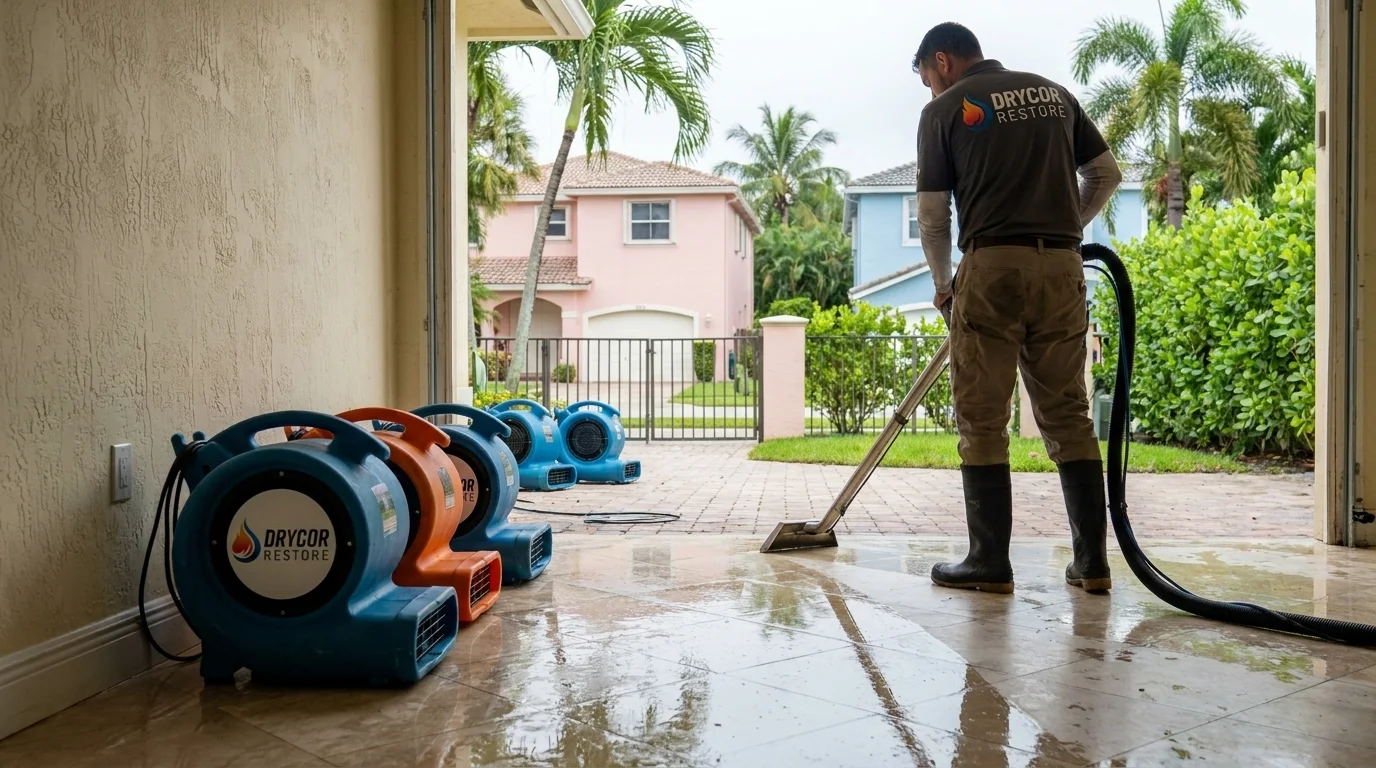
Once the boundary is established, truck-mounted extraction equipment removes standing water from affected rooms. For slab-on-grade homes, which represent the majority of Seminole’s residential stock, desiccant or refrigerant dehumidifiers are positioned to draw moisture out of the concrete itself, not just the air above it. Drying typically requires multiple days of continuous equipment operation with daily moisture readings to confirm progress. Documentation of those readings goes directly into the claim file, which matters when coordinating with your insurance carrier.
Reaching Seminole from Thonotosassa
The drive from DRYCOR RESTORE’s Thonotosassa base to Seminole follows US-92 west to I-275 south, then exits onto Ulmerton Road or Park Boulevard depending on the specific address. That corridor stays accessible around the clock, which is relevant because water emergencies do not wait for business hours. Whether the call comes in at noon or 2 a.m., the same 24/7 dispatch connects directly to a crew that can mobilize immediately. Seminole’s grid layout, with major east-west corridors like 102nd Avenue and Seminole Boulevard, makes navigation straightforward once crews are in the area.
Local Note: What Older Seminole Homes Do to Drying Timelines
Homes built in Seminole during the 1960s and early 1970s frequently used concrete block construction with interior plaster walls rather than the paper-faced drywall that became standard later. Plaster absorbs water more slowly than drywall, which sounds like an advantage, but it also releases moisture more slowly during the drying phase. In practice, this means a water loss in a block-and-plaster Seminole home may require 30 to 50 percent more drying time than a comparable loss in a newer frame home, and pulling wall materials prematurely can leave residual moisture that creates conditions favorable to mold colonization within days. Knowing that pattern before setting up equipment changes how drying systems are staged and how long monitoring continues.
If you are dealing with standing water, soaked flooring, or a loss that happened hours ago and has already had time to spread, call DRYCOR RESTORE at (813) 829-1091. The team is available around the clock, and getting a certified crew on-site quickly in Seminole is the most effective way to limit how far the damage travels before drying begins.
Serving Seminole from our Thonotosassa headquarters — ★ 5.0 · 23 Google reviews
“A company with a long track record! Willow is great to deal with and really cares. No one wants to use the service but can not mess around with having mold in Florida” — Shane, July 2026Read our reviews on Google →
Emergency Water Cleanup in Seminole: Service Coverage
Frequently Asked Questions
How fast can you arrive for emergency water cleanup in Seminole?
How quickly can DRYCOR RESTORE reach a Seminole address after an emergency call?
Does Seminole's high water table affect how water cleanup is performed in slab homes?
Are Seminole homes built in the 1960s and 1970s harder to dry after a water loss?
Will my Pinellas County homeowner's insurance cover emergency water cleanup in Seminole?
How do I know if water has reached areas I cannot see in my Seminole home?
Emergency Water Cleanup response in Seminole
Most Seminole calls see a technician on-site within 60 minutes from our Thonotosassa headquarters.