
Mold Remediation in Seminole
24/7 mold remediation in Seminole, FL. IICRC-certified, insurance billing accepted. Call (813) 829-1091.
Our IICRC-certified technicians are dispatched from our Thonotosassa, FL headquarters and are typically on-site in Seminole within 60 minutes of your call.
Seminole sits in one of the most persistently humid corridors of Pinellas County, where afternoon thunderstorms roll in from Tampa Bay and Gulf moisture lingers long after the rain stops. That combination of high ambient humidity, warm temperatures year-round, and the area’s significant stock of slab-on-grade homes built in the 1960s and 1970s creates conditions where mold can begin colonizing a wet surface in as little as 24 to 48 hours. When you find discoloration behind a cabinet, a musty odor in a bedroom closet, or visible growth spreading across drywall, the clock is already running.
Why Seminole Properties See Mold Issues
The housing stock throughout Seminole skews older, and that matters for mold. Homes built before the mid-1980s often used paper-faced drywall and cellulose-based insulation that absorb moisture readily and give mold a ready food source. Flat or low-slope rooflines common in the ranch-style construction popular in this part of Pinellas County can allow water to pond and infiltrate at fascia and soffit joints, sending moisture into wall cavities without obvious interior signs.
Seminole’s position between two bodies of water, the Gulf to the west and Tampa Bay to the east, means the air rarely fully dries out. Even without a direct water intrusion event, sustained indoor relative humidity above 60 percent is enough to feed surface mold on grout, wood framing, and HVAC ductwork. Homes with older central air systems that run longer cycles to compensate for aging efficiency lose their dehumidification advantage, and condensation on supply registers and inside air handlers becomes a recurring mold source.
Our Mold Remediation Process in Seminole
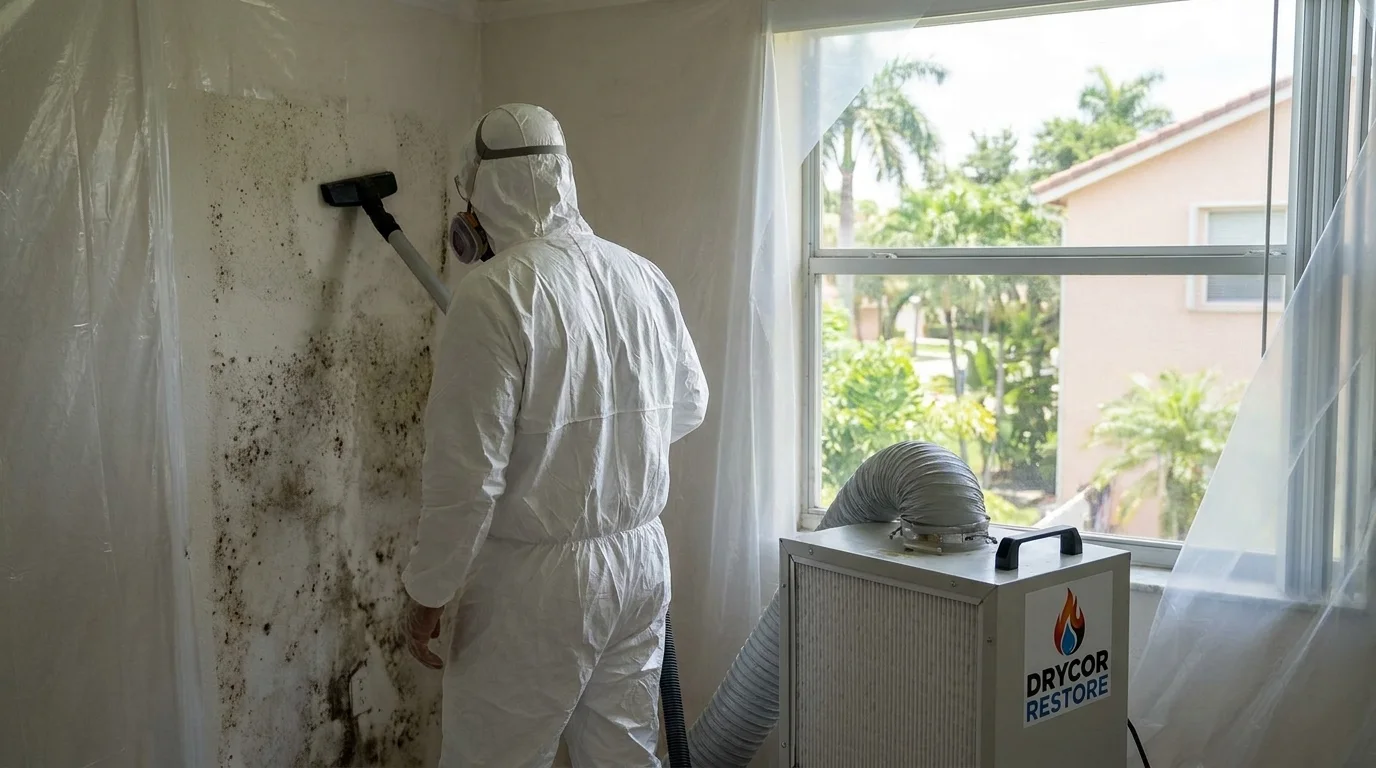
Every remediation starts with a thorough inspection, not a visual pass. Moisture meters and thermal imaging cameras reveal saturation behind walls and under flooring that looks dry to the eye. Once the scope is mapped, containment goes up: negative air pressure barriers isolate the affected area so spores cannot migrate to clean rooms during removal.
Contaminated materials are removed following IICRC remediation guidelines and EPA protocols. Because DRYCOR RESTORE holds NAERMC mold certification and is an IICRC Certified Firm, the work follows a defined standard rather than a contractor’s best guess. After physical removal, affected surfaces are HEPA-vacuumed and treated with an EPA-registered antimicrobial agent. Industrial-grade air scrubbers with HEPA filtration run continuously through the work period to capture airborne spores.
Final clearance involves post-remediation verification, typically a third-party air quality test, to confirm spore counts have returned to normal background levels before containment comes down. In Seminole’s climate, skipping that step is a risk: ambient outdoor spore counts are already elevated compared to drier regions, so the bar for “normal” has to be measured, not assumed.
Reaching Seminole from Thonotosassa
DRYCOR RESTORE operates 24/7 out of Thonotosassa, and the primary route to Seminole runs west on SR-60 through Brandon and into the Pinellas corridor, or south on I-75 to I-275 across the Howard Frankland Bridge. Either path puts a crew into the Seminole area without navigating the congestion that builds on US-19 during peak hours. For calls that come in late evening or early morning, those routes stay clear and allow for a faster on-site arrival than the daytime commute would suggest.
Seminole Insurance and HOA Coordination
Mold claims in Florida carry specific documentation requirements, and carriers often request a written scope of work, moisture readings, and photographic evidence before approving remediation costs. DRYCOR RESTORE documents every step, from initial moisture mapping through final clearance, in a format that supports the claim file your adjuster needs.
Seminole has a mix of single-family neighborhoods and condominium associations, and HOA-governed properties sometimes require advance notice before work begins or mandate that contractors carry specific insurance thresholds. The license number on file, CBC1253966, along with the company’s insurance documentation, satisfies most association requirements. Calling ahead to confirm HOA protocols before the crew arrives prevents delays on jobs where access or staging is controlled by association rules.
Local Note
Older Seminole homes with terrazzo floors, a common feature in Pinellas County construction from the 1950s through the 1970s, present a specific challenge during mold remediation. Terrazzo sits directly on the slab with little or no vapor barrier beneath it in many of these builds. When a plumbing leak or appliance overflow saturates the slab, moisture wicks upward through the terrazzo and into the base of adjacent walls. Surface readings on the terrazzo itself can look acceptable while the wall framing directly above holds significant moisture. Thermal imaging at the wall-floor junction is the step that catches this pattern before a remediation is closed out prematurely.
If you are seeing mold growth, smelling a persistent musty odor, or dealing with a recent water event in your Seminole home, call DRYCOR RESTORE at (813) 829-1091. The team is available around the clock, and the process starts with an honest assessment of what is actually there, not a sales pitch.
Serving Seminole from our Thonotosassa headquarters — ★ 5.0 · 23 Google reviews
“A company with a long track record! Willow is great to deal with and really cares. No one wants to use the service but can not mess around with having mold in Florida” — Shane, July 2026Read our reviews on Google →
Mold Remediation in Seminole: Service Coverage
Frequently Asked Questions
How fast can you arrive for mold remediation in Seminole?
How quickly can DRYCOR RESTORE reach Seminole for a mold emergency?
Does Seminole's year-round humidity affect how long mold remediation takes?
Are the older slab-on-grade homes common in Seminole harder to remediate for mold?
Will my Florida homeowner's insurance cover mold remediation in Seminole?
What does the post-remediation clearance test involve, and is it required in Seminole?
Mold Remediation response in Seminole
Most Seminole calls see a technician on-site within 60 minutes from our Thonotosassa headquarters.