
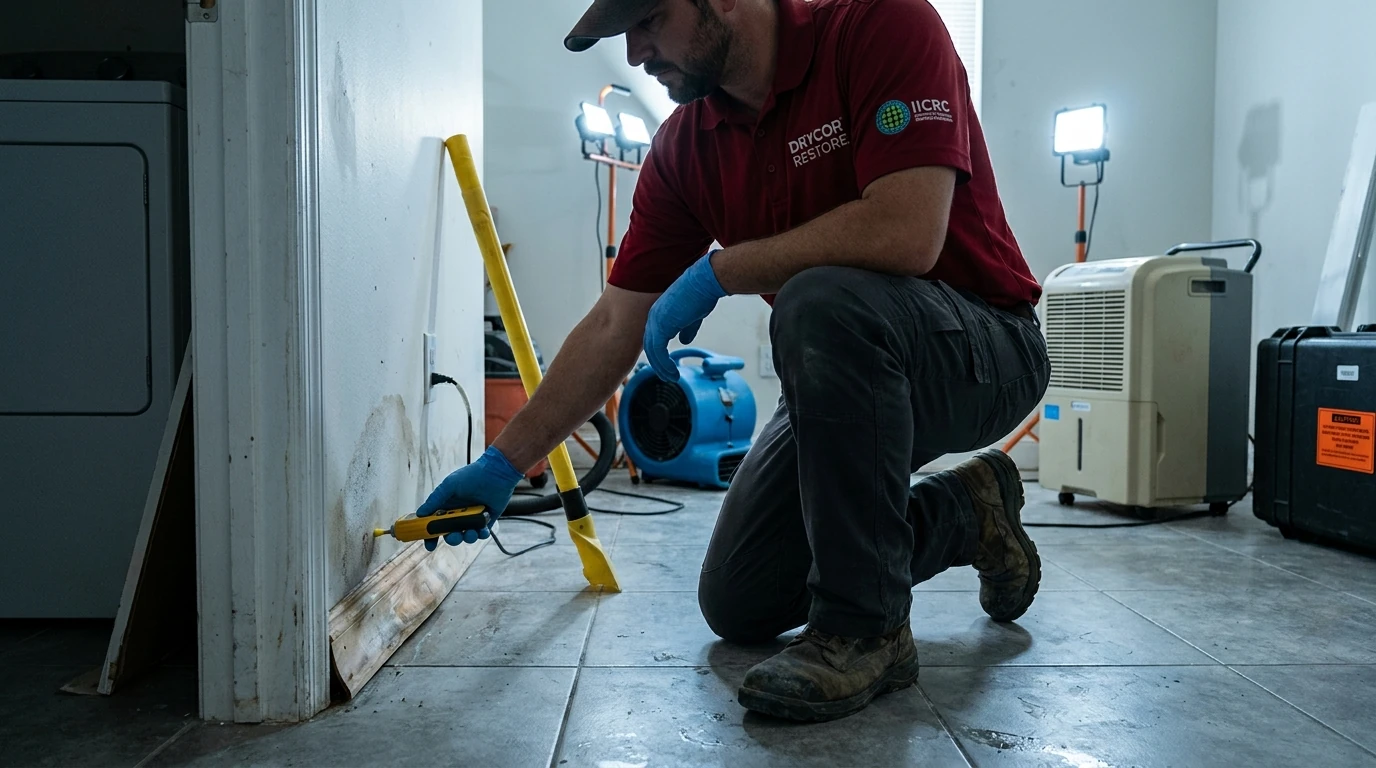
TL;DR: Water damage restoration in the Tampa Bay area typically costs $1,500 to $5,000 for a single-room loss, $5,000 to $12,000 for a whole floor, and $12,000 to $30,000 or more for a whole-home event. The water category (clean, gray, or black) and Florida’s year-round humidity both push costs up. Most standard homeowners policies cover sudden, accidental losses after your deductible. Every job is different, and a written scope from a certified contractor protects both your claim and your wallet.
Your washing machine supply line let go overnight. Or a toilet seal failed. Or a pipe cracked behind the wall and you found it three days later. Whatever happened, you’re now staring at wet floors, swelling baseboards, and a question that every Tampa Bay homeowner asks in this moment: what is this going to cost me?
The honest answer depends on four things: how much area got wet, how long the water sat, what kind of water it was, and how Florida’s humidity affects the drying timeline. This guide breaks each factor down with real numbers so you can walk into an insurance call or a contractor conversation knowing what to expect.
How much does water damage restoration cost by loss size?
Most restoration costs in the Tampa Bay area fall into three tiers based on how many rooms and how many structural materials were affected. A single bathroom or laundry room with a contained leak runs $1,500 to $5,000. A whole floor with water migrating under multiple rooms runs $5,000 to $12,000. A whole-home event, think a burst main line or a roof intrusion that reached the first and second floor, runs $12,000 to $30,000 or more.
| Loss Scenario | Typical Cost Range |
|---|---|
| Single room, clean water (Cat 1) | $1,500 - $4,500 |
| Single room, gray water (Cat 2) | $3,000 - $7,000 |
| Whole floor, clean water | $5,000 - $12,000 |
| Whole floor, gray or black water | $8,000 - $18,000 |
| Whole-home event (multi-floor) | $12,000 - $30,000+ |
| Sewage backup, contained area | $3,500 - $10,000 |
These are industry-typical ranges for the Tampa Bay market, not a quote or a guarantee. DRYCOR RESTORE provides a written scope of work before any restoration begins so you know exactly what you are approving.
What is the cost per square foot for water damage restoration?
Water damage restoration typically costs $3.75 to $7.00 per square foot for drying and mitigation alone, before any repairs or reconstruction. That range shifts based on the water category, the materials involved (carpet vs. hardwood vs. concrete slab), and how many days of equipment run time the job requires.
Mitigation (extracting water, drying the structure, applying antimicrobial treatments) is usually billed separately from reconstruction (replacing drywall, flooring, cabinets). When you see a total estimate, make sure you understand which phase each line item covers. A $4,500 mitigation invoice does not include the $3,000 to $8,000 it might cost to replace the flooring and drywall afterward.
For a deeper look at statewide cost patterns, see our companion post: How Much Does Water Damage Restoration Cost in FL? (2026).
How does water category affect the price?
The IICRC S500 standard, the industry’s governing document for water damage restoration, classifies water into three categories based on contamination level. Category determines how aggressively the affected materials must be treated and whether porous materials can be dried in place or must be removed entirely.
- Category 1 (clean water): Comes from a supply line, a faucet, or a toilet tank (not the bowl). Lowest contamination risk. Porous materials can often be dried in place if treated quickly. Lowest cost tier.
- Category 2 (gray water): Comes from a dishwasher, washing machine drain, or toilet bowl overflow without feces. Contains contaminants that can cause illness. Porous materials typically require removal if they absorbed the water.
- Category 3 (black water): Sewage backups, floodwater from outside, or any water that has been sitting long enough to support microbial growth. Highest contamination risk. Most porous materials that absorbed Cat 3 water must be removed and disposed of, not dried. This is the most expensive category to remediate.
Water category can also change over time. Clean water from a supply line that sits untreated for 48 to 72 hours in Florida’s humidity can degrade to Category 2 or 3 as bacteria multiply. That is one reason rapid response matters so much here, and why the IICRC S500 standard sets clear protocols for response timing.
Why does Florida humidity make water damage restoration more expensive?
Florida’s average relative humidity runs 70 to 90 percent for much of the year, and the Tampa Bay area sits in one of the most persistently humid corridors in the continental U.S. That matters for restoration cost because drying is not just about removing standing water. It is about driving moisture vapor out of structural materials, and high ambient humidity fights that process every hour.
In a drier climate, a standard residential drying job might require 3 to 4 days of equipment run time. In Tampa Bay, the same structural moisture load can take 5 to 7 days because the air outside is already saturated. Equipment runs longer. Equipment-day billing adds up. LGR (low-grain refrigerant) dehumidifiers, which are the workhorses of commercial drying, pull moisture from the air more efficiently than standard dehumidifiers, but they still run on a daily rental basis, typically $125 to $175 per unit per day.
A 1,200 square foot first-floor loss might require 4 to 6 air movers and 2 to 3 LGR dehumidifiers running for 5 to 7 days. That equipment cost alone can reach $3,500 to $6,000 before any labor or materials. Florida homeowners should factor this into their expectations when reviewing estimates.
If mold growth starts during or after the drying process, costs increase further. Mold can begin colonizing wet materials in as little as 24 to 48 hours in warm, humid conditions. Our post on signs of hidden mold covers what to watch for after a water loss.
Does homeowners insurance pay for water damage restoration?
Most standard homeowners policies cover sudden, accidental water damage, meaning a pipe burst, an appliance failure, or an HVAC condensate line overflow. They typically exclude gradual leaks (a slow drip behind a wall that went unnoticed for months), flooding from outside the home, and sewer backup unless you purchased a separate rider.
Here is how the insurance process typically works on a covered water loss:
- You call your insurer and open a claim. Do this after the water is stopped and emergency extraction is underway, not before.
- The insurer assigns an adjuster who will review the scope of damage.
- Your restoration contractor documents the loss with moisture readings, photos, and a written scope. This documentation is what protects your claim.
- The insurer issues payment minus your deductible. Standard deductibles run $1,000 to $2,500 on most Florida policies, though wind/storm deductibles are often higher.
- Reconstruction begins after the structure is dry and the adjuster approves the repair scope.
For a full breakdown of what policies cover and what they exclude, see our guide: Does Homeowners Insurance Cover Water Damage? A Plain-English Guide.
One practical note: Florida homeowners with older homes should be aware that code-upgrade provisions in their policy (sometimes called Ordinance or Law coverage) may cover the cost of bringing repaired areas up to current building code. This matters if your home has older wiring, plumbing, or insulation that must be updated when walls are opened.
What should you do in the first 24 hours to protect your claim and your home?
The first 24 hours after a water loss determine both the final cost and the strength of your insurance claim. Acting fast limits secondary damage, which insurers may not cover if they determine it was preventable.
- Stop the water source. Shut off the supply valve at the fixture or the main shutoff if needed.
- Call a certified restoration contractor. IICRC-certified firms carry the training and equipment to begin extraction and drying immediately. 24/7 response matters here.
- Document everything before extraction begins. Photos and video of standing water, affected materials, and visible damage.
- Open your claim. Call your insurer after the emergency response is underway.
- Do not run fans from a hardware store as a substitute for professional drying equipment. Household fans move air but do not dehumidify. They can spread moisture to unaffected areas and create conditions for mold growth.
For a step-by-step checklist, see What To Do in the First 24 Hours After Water Damage.
If you are dealing with a burst pipe specifically, our Burst Pipe Emergency Checklist walks through the immediate response.
How do you get an accurate water damage restoration estimate?
An accurate estimate starts with a thorough moisture assessment, not a visual inspection alone. Certified technicians use thermal imaging cameras and calibrated moisture meters to map the full extent of water migration, which is often larger than what is visible to the eye. Water follows framing cavities, travels under flooring, and wicks up drywall well beyond the wet spot you can see.
When reviewing any estimate, look for:
- Line-item detail (extraction, equipment, labor, antimicrobial treatment listed separately)
- Equipment count and projected run days
- Scope separation between mitigation and reconstruction
- A written authorization before work begins
A verbal estimate or a flat-rate quote without a moisture map is a red flag. The scope should be based on what the moisture readings actually show, not on a visual guess.
DRYCOR RESTORE serves Tampa, Thonotosassa, and the surrounding Tampa Bay area with water damage restoration and emergency water cleanup backed by IICRC WRT certification and 24/7 response. If you have standing water or a recent loss, call (813) 829-1091 to schedule a moisture assessment.
About DRYCOR RESTORE
DRYCOR RESTORE is an IICRC Certified Firm serving Tampa and the greater Tampa Bay area since 2005 (license CBC1253966). The company holds IICRC WRT (Water Restoration Technician) certification and is EPA Lead-Safe Certified and OSHA trained. Their crews handle water damage restoration, emergency water cleanup, sewage cleanup, mold remediation, fire damage restoration, storm damage restoration, contents restoration and storage, general contracting, and emergency board-up and tarping across Hillsborough, Pinellas, Polk, Pasco, and Manatee counties.
Video Transcript
Your washing machine line burst overnight. Now you’re staring at wet floors and swelling baseboards, and one big question: what is this going to cost? In Tampa Bay, most water damage jobs fall into three tiers. A single room runs $1,500 to $5,000. A full floor, $5,000 to $12,000. A whole-home event, burst main line, roof intrusion, can reach $12,000 to $30,000 or more depending on the scope. Mitigation, extracting water, drying the structure, typically costs $3.75 to $7.00 per square foot. That’s billed separately from any reconstruction. The type of water matters too. Clean supply-line water costs the least. Gray water from a washing machine drain costs more. Sewage backup is the most expensive to remediate. Here’s a Florida-specific factor most homeowners miss. Our humidity, 70 to 90 percent year-round, slows drying significantly, adding equipment days to every job. Professional drying equipment, dehumidifiers and air movers, runs $125 to $175 per unit per day. A typical first-floor loss can mean $3,500 to $6,000 in equipment costs alone. A moisture meter tells your contractor when the structure is truly dry, not just when it looks dry. Always ask to see the final readings before equipment is removed. Every job is different. Get the facts before you sign anything. Call DRYCOR RESTORE at (813) 829-1091 for a free estimate.