TL;DR: Water damage restoration in Florida typically costs $1,500 to $7,500 for a single-room clean-water loss and can reach $15,000 to $30,000 or more for large-area Category 3 (sewage or floodwater) events. The biggest cost drivers are water category, square footage, materials affected, and how fast mitigation starts. Florida’s humidity makes response time especially critical, mold can begin colonizing wet drywall within 24 to 48 hours in Tampa Bay-area conditions.
If you just walked into standing water in your home and you’re trying to figure out what this is going to cost before you call anyone, this guide gives you the real numbers. These are industry-typical ranges based on the IICRC S500 Standard for Professional Water Damage Restoration, the benchmark every certified restoration firm in Florida works from. Every loss is different, and a written scope of work before any work begins is the only number that actually applies to your specific situation.
How Much Does Water Damage Restoration Cost in Florida?
In Florida, water damage restoration typically costs $3 to $8 per square foot for extraction and drying, with total project costs ranging from $1,500 to $30,000 depending on the severity of the loss. A 200-square-foot bathroom with a burst supply line and clean water runs $1,500 to $4,000. A 1,500-square-foot first floor with Category 2 water from a failed appliance runs $6,000 to $14,000. A whole-house Category 3 event from sewage backup or storm surge can exceed $30,000 once structural drying, antimicrobial treatment, and material replacement are factored in.
Here are typical ranges by scenario:
| Scenario | Typical Cost Range |
|---|---|
| Single room, Category 1 (clean water) | $1,500 - $4,000 |
| Multi-room, Category 1 (burst pipe) | $3,500 - $8,000 |
| Single room, Category 2 (gray water, appliance) | $2,500 - $6,000 |
| Multi-room, Category 2 (washing machine, dishwasher) | $5,000 - $12,000 |
| Category 3 (sewage backup, floodwater) | $7,000 - $30,000+ |
| Crawl space or subfloor drying | $2,000 - $8,000 |
| Contents pack-out and restoration | $1,500 - $10,000 |
These are mitigation costs only. If structural repairs, drywall replacement, flooring, or cabinetry are needed after drying is complete, that reconstruction phase adds cost on top.
What Factors Move the Price Up or Down?
Five factors account for most of the cost variation in Florida water damage jobs.
Water category. The IICRC classifies water in three categories. Category 1 is clean water from a supply line or rain intrusion. Category 2 is gray water with biological contaminants (washing machine discharge, toilet overflow without solids). Category 3 is black water, sewage, floodwater, or any water that has been standing long enough to become grossly contaminated. Category 3 requires full PPE, antimicrobial treatment, and often complete material removal. It costs two to three times more than a comparable Category 1 loss.
Class of loss (how wet things got). Class 1 means minimal absorption, water stayed on hard surfaces. Class 4 means specialty drying is needed for hardwood floors, concrete, or plaster. Class 4 jobs require low-grain refrigerant (LGR) dehumidifiers and longer drying cycles, which adds equipment time and cost.
Square footage and materials affected. Drywall, insulation, and hardwood absorb water and often need removal. Tile and concrete do not. A kitchen with tile floors costs less to dry than the same square footage with hardwood and plaster walls.
Response time. Florida’s average relative humidity runs 70 to 90 percent in summer. The EPA’s guidance on mold notes that mold growth can begin within 24 to 48 hours on wet organic materials. Every hour of delay in the Tampa Bay area increases the probability of secondary mold damage, which adds remediation cost on top of the restoration bill.
Structural complexity. Water that reaches wall cavities, subfloors, or ceiling assemblies requires more equipment, longer drying times, and more invasive demolition to verify drying. A moisture meter reading at the surface does not tell you what is happening inside a wall cavity, thermal imaging and deep-wall probes are needed for accurate assessment.
What Does the Restoration Process Actually Involve?
Knowing the steps helps you understand what you’re paying for and what to ask for in a written scope.
- Emergency extraction. Truck-mounted or portable extractors remove standing water. This is the fastest phase, a crew can extract a flooded room in one to two hours.
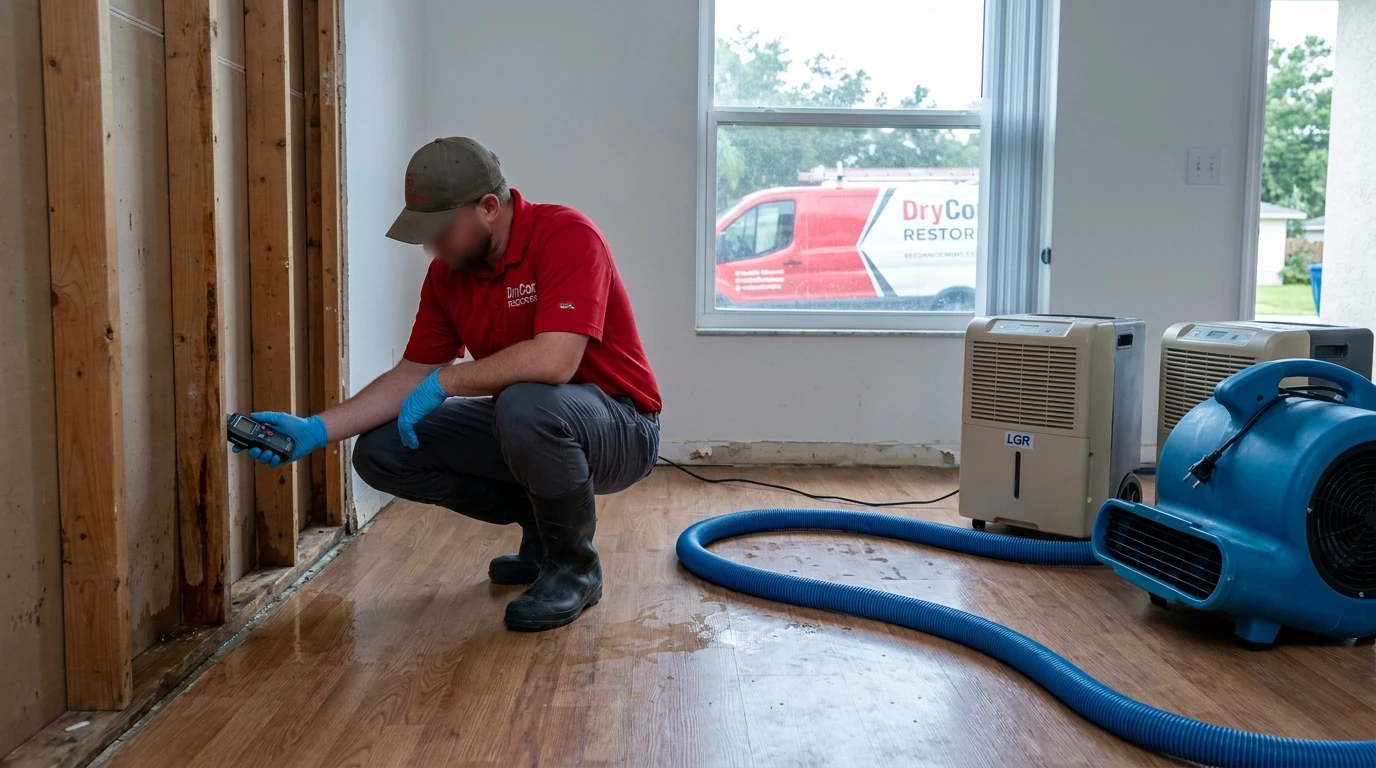
- Moisture mapping. Technicians use thermal imaging cameras and calibrated moisture meters to document the extent of saturation. This documentation is also what your insurance adjuster needs.
- Controlled demolition (if needed). Wet drywall below the flood cut line, saturated insulation, and buckled flooring are removed. Leaving wet materials behind traps moisture and causes mold.
- Structural drying. Air movers (high-velocity fans) and LGR dehumidifiers run continuously, typically three to five days for a Class 2 loss in Florida conditions. Drying logs are recorded daily.
- Antimicrobial treatment. Applied to all affected structural surfaces, especially for Category 2 or 3 losses.
- Clearance verification. Moisture readings must return to normal dry standard for the material type before equipment is removed. This is not optional, pulling equipment early to save cost is the most common cause of mold callbacks.
- Reconstruction. Drywall, insulation, flooring, and finishes are reinstalled. This is a separate phase and a separate cost estimate.
For a step-by-step guide to what you should do before the crew arrives, see What To Do in the First 24 Hours After Water Damage.
Will Homeowners Insurance Cover Water Damage Restoration in Florida?
Most standard homeowners policies cover sudden and accidental water damage but exclude gradual leaks, flooding, and maintenance-related failures. A burst pipe covered. A slow leak under the sink that went unnoticed for six months, typically not covered, or covered only partially.
Florida-specific notes:
- Flood damage (storm surge, rising groundwater, overland flooding) is NOT covered by standard homeowners insurance. It requires a separate National Flood Insurance Program (NFIP) policy or private flood coverage. This distinction matters enormously in coastal and low-lying areas of Hillsborough and Pinellas counties.
- Assignment of Benefits (AOB) laws in Florida changed significantly in 2023. Homeowners now deal directly with their insurer rather than assigning their claim to a contractor. Understand this before signing any paperwork.
- Documentation is your claim. Restoration firms that do proper moisture mapping, drying logs, and photo documentation give your adjuster what they need to approve the full scope. Firms that skip documentation leave you negotiating without evidence.
For a plain-English breakdown of what policies actually cover, see Does Homeowners Insurance Cover Water Damage?
What Should You Do Right Now?
If water is still present in the structure, the most important thing is stopping the source and starting extraction as fast as possible. In Florida’s climate, the 24-hour window before mold risk escalates is real.
For a burst pipe situation specifically, the Burst Pipe Emergency Checklist walks through the immediate steps before a crew arrives.
When you call a restoration company, ask for three things before work starts: a written scope of work, a moisture map showing the extent of damage, and confirmation that drying logs will be provided for your insurance claim. Any reputable IICRC-certified firm will provide all three without hesitation.
For water damage restoration in Thonotosassa and across the Tampa Bay area, DRYCOR RESTORE (license CBC1253966) is available 24/7 at (813) 829-1091. Their IICRC WRT-certified crews handle extraction, structural drying, sewage cleanup, and storm damage restoration, and they provide the documentation your insurance adjuster needs from the first call.
About DRYCOR RESTORE
DRYCOR RESTORE is an IICRC Certified Firm serving Tampa, Brandon, and the greater Tampa Bay region since 2005 (license CBC1253966). The company holds IICRC WRT (Water Damage Restoration Technician) certification, EPA Lead-Safe certification, NAERMC mold certification, and is OSHA trained. Services include water damage restoration, emergency water cleanup, sewage cleanup, mold remediation, fire damage restoration, storm damage restoration, contents restoration and storage, emergency board-up and tarping, and general contracting.