
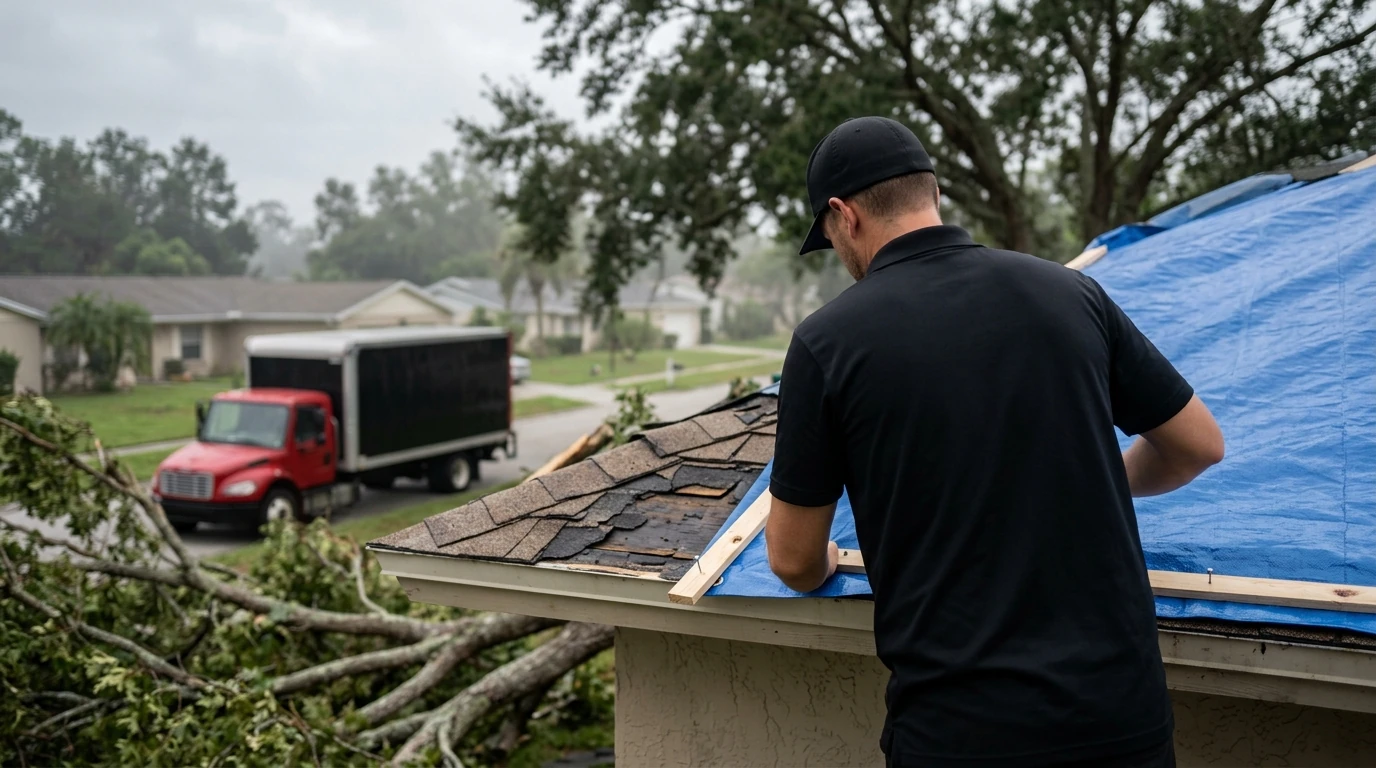
If a live oak just came down through your roof in Thonotosassa, the order you make calls in matters more than how fast you make them. Call the wrong company first and you can lose hours while rain keeps pouring through the hole. Here is the order that actually protects the house and the claim: get people out of the room, check for downed power lines or a gas smell, call your insurer to open the claim, call a tree service to cut and remove the tree, then call a storm restoration crew at (813) 829-1091 to tarp the opening and start drying out whatever got wet underneath.
Thonotosassa’s heavy live oak canopy, especially around Lake Thonotosassa and near Hillsborough River State Park, means this is a common call here during summer storm season and in the outer bands of a tropical system. The order above is the same whether a branch punched a hole in a shingle roof or a whole trunk is resting across the ridge line.
Is anyone in danger right now?
Before any phone call, get everyone out of the rooms directly under or near the damage and stay out until a professional confirms the structure is stable. A tree through a roof can leave rafters cracked or a ceiling holding weight it was never built for, and that is not something to test by walking underneath it.
Look outside before you walk the yard. If any part of the tree is touching a power line or a line is down anywhere nearby, stay back and call your utility provider, not 911 for a non-emergency, and not a tree service. Downed lines stay live even when they look dead. If you smell gas, leave the house and call the gas company from outside.
Once the scene is confirmed safe, take photos of the tree, the hole, and any water coming in before you touch anything. Your insurer and your contractor will both want that documentation.
Who do I actually call, and in what order?
Call your homeowners insurer first to open the claim, then a tree removal company to get the trunk and limbs off the structure, then a storm damage restoration company to close up the hole and handle whatever water got inside. Each of those three does a different job, and none of them substitutes for the others.
Your insurer assigns a claim number and, for many Florida carriers, that claim number is what a restoration crew needs on file before starting emergency work under your policy. Call them early, even from the yard.
Tree removal is its own trade. A storm restoration crew, including DRYCOR RESTORE, does not cut down or haul away trees. That work takes a crane, a bucket truck, chainsaw crews insured for that specific hazard, and often a permit depending on the size of the tree and whether it is blocking a right-of-way. Call an arborist or tree removal company for that part, and ask if they coordinate with restoration crews regularly since that handoff happens often after Florida storms.
Once the tree is off, the race is against water, not the tree. Rain through an open roof can soak insulation, drywall, and framing within hours, and mold can begin growing on wet material in as little as 24 to 48 hours according to the EPA. That is the restoration company’s job: emergency tarping or board-up, water extraction, and drying the structure before it becomes a second problem on top of the hole in the roof.
What happens when you call a restoration crew?
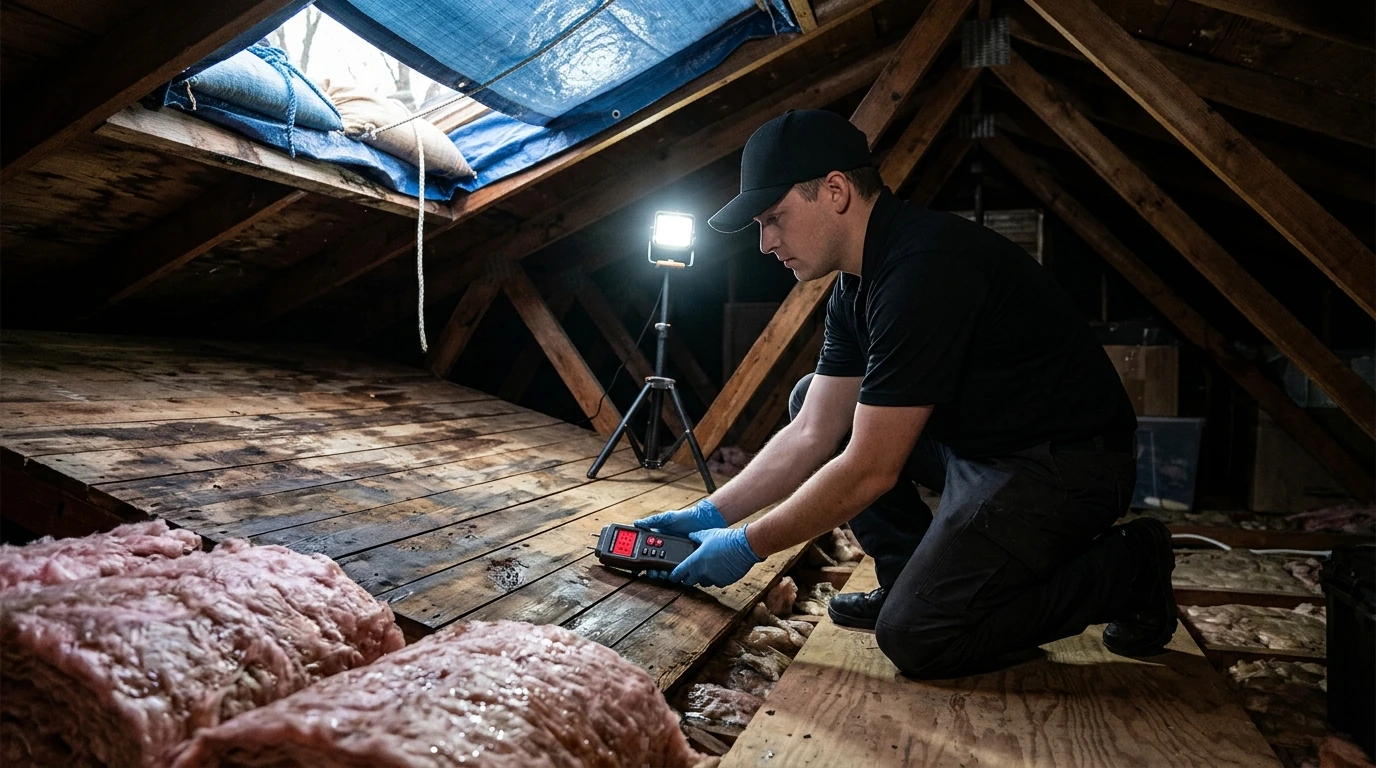
A restoration crew’s first job on the phone is to get your address, the claim number if you have it, and a description of where the opening is, then dispatch a crew for emergency tarping and water mitigation. DRYCOR RESTORE answers calls 24/7 and documents the loss with photos and moisture readings before any work starts, which becomes part of your insurance file.
On arrival, the crew tarps or boards the opening first to stop ongoing water intrusion, since every additional hour of rain through a hole makes the drying job bigger. They will walk the attic and the rooms below with a moisture meter to map how far the water traveled, because a tree strike rarely stays confined to the room directly under the hole.
If the water reached drywall, insulation, or flooring, extraction and structural drying follow the same ANSI/IICRC S500 standard used on any water loss, with air movers and dehumidifiers run until moisture readings confirm the materials are dry, not just dry to the touch. Our water damage restoration and emergency board-up and tarping pages walk through what that process looks like in more detail.
Does homeowners insurance cover a tree falling on the house?
Most standard homeowners policies cover the structural damage when a tree falls on a covered building, because wind and falling objects are typically named covered perils, but tree removal coverage often has its own smaller limit. According to the Insurance Information Institute, the roof, drywall, and framing repair is usually treated under dwelling coverage, while removing the tree itself may be capped at a few hundred to a couple thousand dollars depending on the carrier, separate from the structural repair limit.
What is not typically covered: damage from a tree that was already dead, diseased, or leaning and should have been removed before the storm, since that falls under maintenance rather than a sudden loss. Document the tree’s condition before removal if you can, in case the carrier asks.
After the roof and interior are tarped, dried, and documented, repairs move into reconstruction: replacing roof decking, drywall, insulation, and framing members that were cracked or soaked. Our reconstruction team handles that phase once the structure is dry and the scope is written. You can review the hurricane and storm damage repair process in Thonotosassa for how that typically plays out from open claim to finished repair.
If a tree is on your Thonotosassa home right now and the scene is safe, open your claim, line up tree removal, and call DRYCOR RESTORE at (813) 829-1091 to get the opening closed and the drying started before the next rain band comes through.