
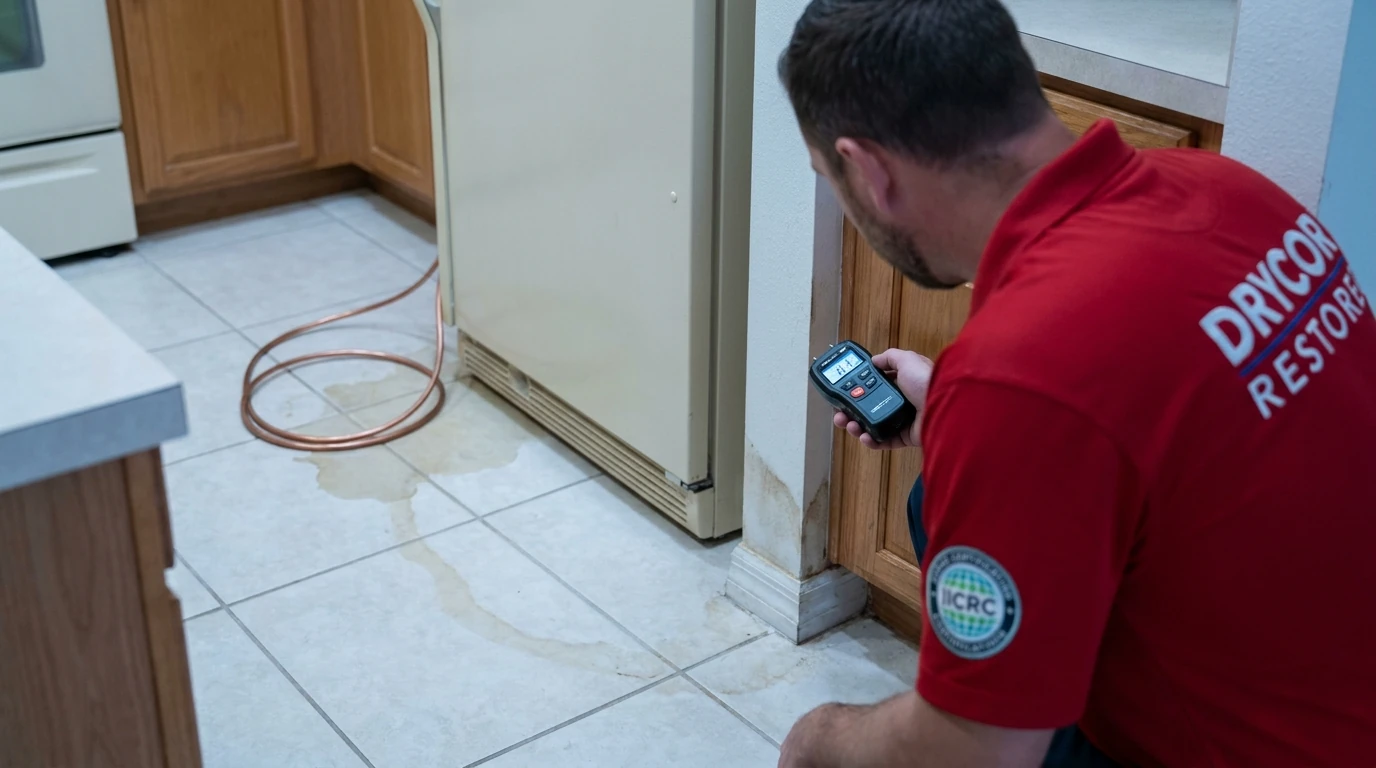
A refrigerator supply line doesn’t pick a convenient time to fail. It usually shows up as a widening dark patch along the kitchen baseboard, sometimes discovered on a weekend, sometimes while the homeowner is out of town. What happens in the hours and weeks after that discovery decides whether the damage stays contained or spreads into the subfloor, the cabinets, and the homeowner’s peace of mind.
Here’s a real review from a DRYCOR RESTORE customer, Margo, describing exactly that situation:
“I had a refrigerator leak in my kitchen, resulting in water damage to my floors and cabinets. I contacted Drycor and they were out assessing my damage within the hour, even though it was a Saturday morning. The owner, Robert Showalter, was extremely sensitive to my emotional state and immediately put me at ease. He took the time to explain the entire process to me, from emergency mitigation, the claims process, and what would be needed to make our home whole again… His crew was polite, efficient, friendly and a pleasure to work with. While I was out of town they stayed in close contact and made sure to update me every time they serviced the drying equipment… He is extremely knowledgeable in the insurance process, and either he or his project manager were present at every meeting I’ve had with the adjuster or subcontractor to make sure nothing is overlooked… After a successful drying process, they were able to save my cabinets and install all new floor and baseboards throughout my home. Carrie was able to source the floors I requested, which was no small task, and the team worked overtime to get everything put back together.”
- Margo, verified Google review
That review packs in almost every stage of a water damage claim. Here’s what each part actually involves.
Why a Saturday-Morning Leak Still Gets Looked at Within the Hour
A fast on-site assessment matters because water keeps moving the entire time nobody is watching it. DRYCOR RESTORE operates on a 24/7 basis, which is why a weekend appliance leak gets the same response priority as a weekday one.
The first visit isn’t just a look-around. A technician checks moisture levels behind cabinet toe-kicks, under flooring, and inside wall cavities with a moisture meter, because water from a refrigerator line travels sideways under flooring long before it’s visible. That reading becomes the baseline every later drying check gets compared against.
What “Emergency Mitigation” Means Before Anyone Talks About Rebuilding
Emergency mitigation is the work that stops a leak from becoming a bigger loss: extracting standing water, pulling damaged material that can’t be saved, and setting equipment to dry what can. It happens before any conversation about new flooring or cabinets, because drying has to be verified complete first.
Drying follows the ANSI/IICRC S500 standard, which sets the framework for how water damage is categorized and how drying progress gets measured and documented, not guessed at. That documentation later becomes part of the insurance file. Explaining this sequence up front, as Margo’s review describes, is what keeps a homeowner from assuming the job is finished the moment the water is gone.
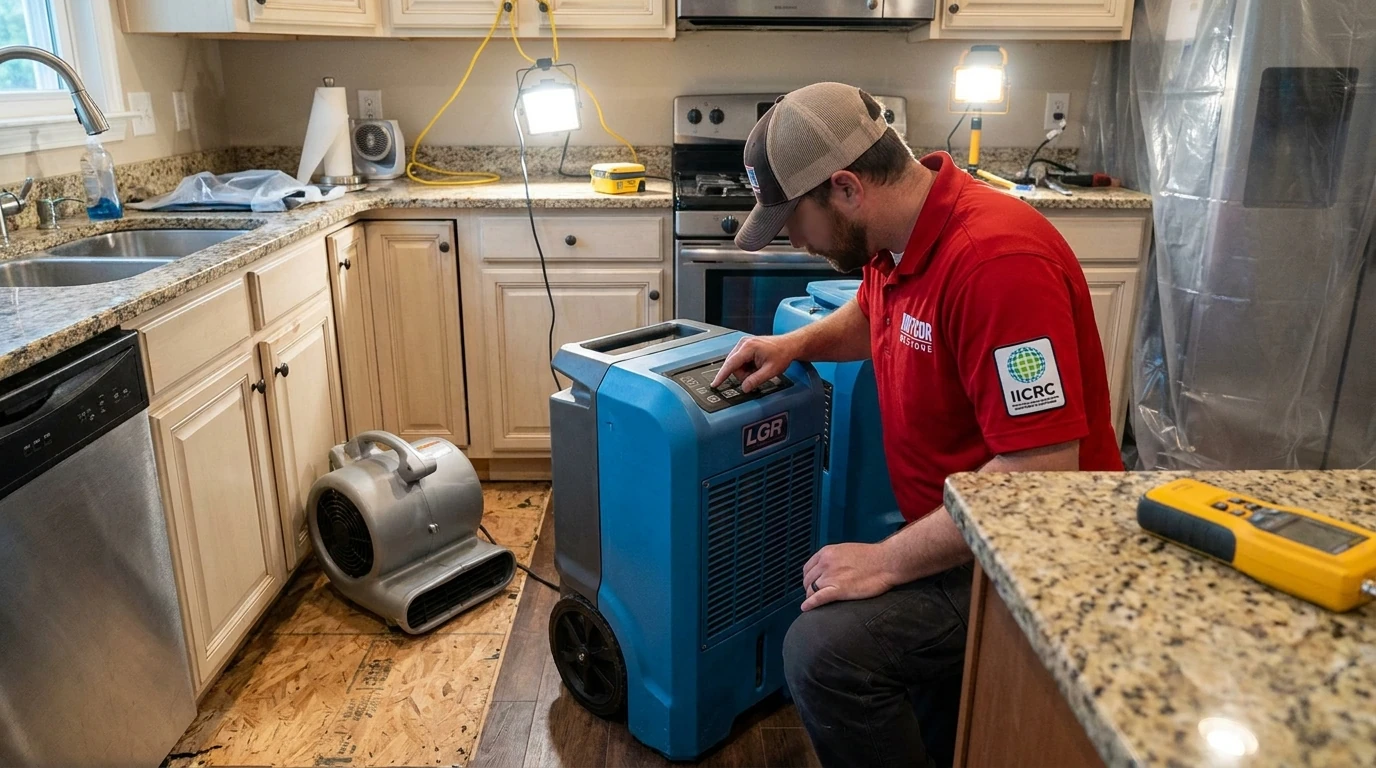
Why Drying Equipment Gets “Serviced,” Not Just Dropped Off
Air movers and dehumidifiers left running in a kitchen need daily monitoring, not a one-time setup. Wood subflooring and cabinet boxes can look dry on the surface while still holding moisture that invites mold if the equipment is pulled too soon.
A technician returns to take new moisture readings, reposition equipment as materials dry at different rates, and log the numbers. For an out-of-town homeowner, a quick update after each visit is the difference between radio silence during a stressful week and actually knowing the drying is on track.
Why a Restoration Company Needs to Understand Insurance, Not Just Construction
The mitigation work and the insurance claim run on parallel tracks, and someone has to manage both at once. Most homeowners policies cover sudden, accidental water damage like a failed appliance line, though coverage details and documentation requirements vary by carrier, which is part of why the Insurance Information Institute recommends homeowners understand their policy’s specifics before a loss happens, not after.
Having someone present at adjuster and subcontractor meetings, as Margo describes, matters because scope gaps are easiest to catch in person. A missed line item in an estimate is much harder to add back in after the paperwork is signed. For a first-time claim, having someone in the room who already speaks the adjuster’s language removes a lot of the guesswork.
From Drying to “Whole Again”: What Gets Saved vs. Replaced
Cabinets and flooring don’t always need full replacement, but they need an honest assessment of which materials survived drying and which didn’t. In Margo’s case, the cabinets were saved while the flooring and baseboards throughout the home were replaced, which is a common split: solid wood cabinet boxes often dry out fine, while laminate or engineered flooring exposed to standing water usually can’t be salvaged.
Sourcing a specific flooring match for a custom kitchen is its own task, separate from the drying work, and it’s one reason mitigation and reconstruction are often handled by the same team rather than handed off between separate companies.
If a leaking appliance, a burst line, or standing water in a kitchen or bathroom has you looking at a similar decision between saving materials and replacing them, DRYCOR RESTORE’s water damage restoration team handles both the mitigation and the insurance documentation from the first visit. Call DRYCOR RESTORE at (813) 829-1091 to schedule an assessment.