Commercial Restoration in Tampa Bay
24/7 commercial restoration in Tampa Bay and surrounding areas. IICRC-certified, insurance billing accepted. Call (813) 829-1091.
Business closed because of water, fire, or storm damage? Every hour a commercial space sits unusable costs lost revenue, missed appointments, and sometimes lease penalties. DRYCOR RESTORE handles commercial losses differently than a residential job: the priority isn’t just drying out materials or clearing soot, it’s getting part or all of the building back into operation while the work is still underway, with documentation that supports a business interruption claim.
What Commercial Restoration actually involves
Commercial losses rarely look like a single-family home loss. A burst supply line on the third floor of an office building can travel through plenum spaces and drop ceilings into two tenants below before anyone notices. A kitchen fire in a strip-mall restaurant can leave adjoining retail spaces with smoke odor and soot film on inventory even though no flame reached them. Commercial restoration covers water, fire, smoke, and storm losses in office buildings, retail spaces, restaurants, warehouses, medical and multi-tenant properties, where the scope of work has to account for occupancy type, shared mechanical systems, and the building owner’s obligation to other tenants.
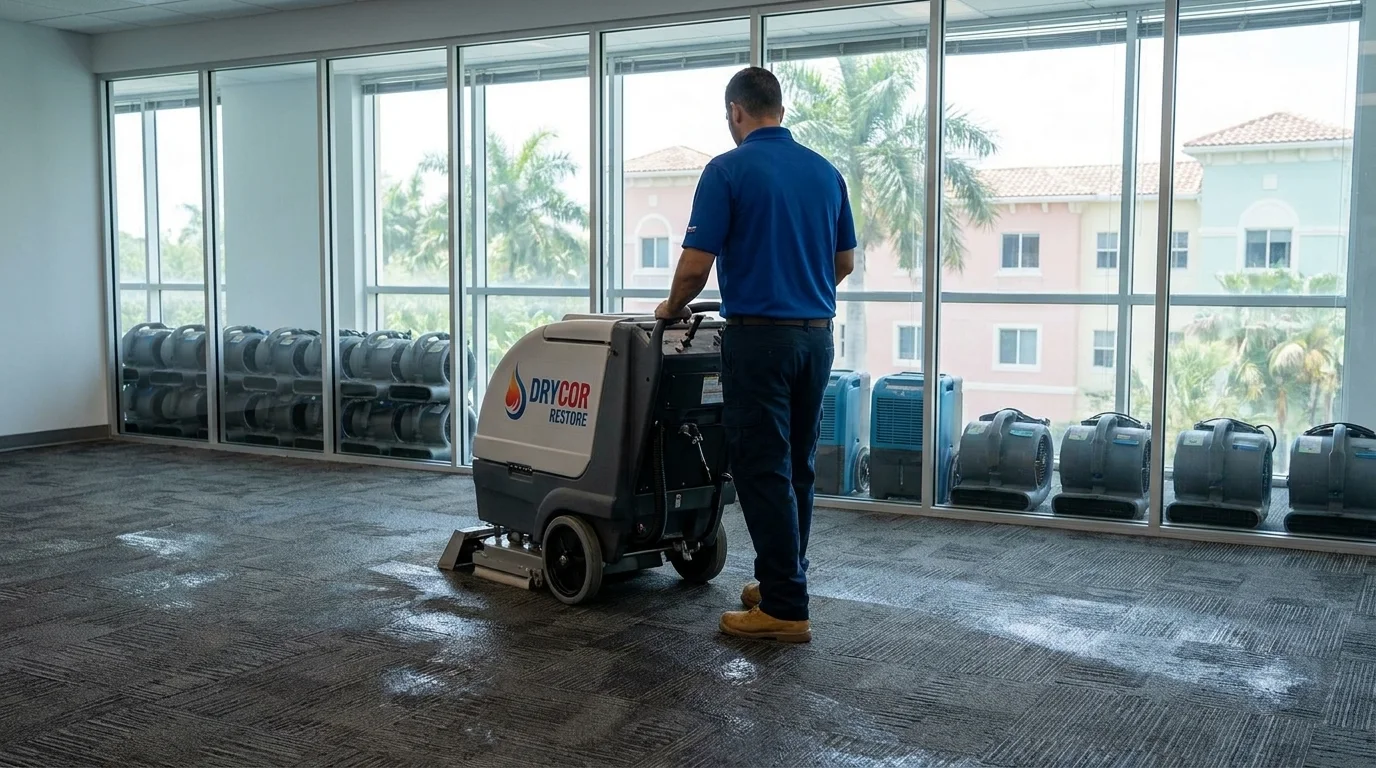
Equipment is sized to the space. Low-grain refrigerant dehumidifiers and high-CFM air movers run in zones so unaffected suites can stay open. Moisture mapping covers concrete slab, metal deck, and drywall assemblies that behave differently than residential wood framing. Fire and smoke jobs often require thermal fogging or ozone treatment in HVAC runs that serve more than one unit, which means coordinating shutdowns with the property’s mechanical contractor, not just the business owner.
Our process
- Site assessment and stakeholder coordination. We walk the affected space with the property manager, tenant, and often the insurance adjuster present, and map which areas are structurally compromised versus merely affected by odor, moisture, or soot migration.
- Containment and phased mitigation. Plastic sheeting, negative air pressure, and zip-wall barriers isolate the loss area so leasable space nearby can stay occupied. Work is often scheduled around business hours when a tenant needs to remain open.
- Extraction, drying, or soot and odor removal. Depending on the loss type, this stage runs commercial dehumidification and air movement per IICRC S500 drying standards, or soot cleaning and thermal fogging for fire and smoke losses, with moisture and air readings logged daily.
- Code compliance and reconstruction. Any rebuild work on commercial occupancies, electrical, fire-rated assemblies, ADA clearances, goes through the appropriate permitting before finish work starts.
- Final walkthrough and documentation handoff. We provide photos, moisture logs, and a scope summary the property owner or manager can hand directly to their carrier or broker for the business interruption claim.
What separates a good commercial restoration response from a bad one
The most common mistake on commercial jobs is treating them like an oversized residential loss. A crew that doesn’t understand return-air plenum paths will miss moisture or soot that traveled into a neighboring suite through the ductwork, and that gets discovered weeks later as a mold or odor complaint. Another frequent gap is documentation: adjusters reviewing a business interruption claim want dated moisture logs, photos tied to specific rooms, and a clear equipment placement record, not a verbal summary after the fact.
Good operators also plan around occupancy. Keeping part of a retail floor or office suite open during mitigation takes real containment work, not just a tarp over a doorway, and it takes coordination with whoever manages the building’s HVAC and electrical systems. Skipping that step is how a single-tenant loss turns into a building-wide odor or air quality complaint.
What does Commercial Restoration cost?
Commercial losses vary enormously depending on building size, occupancy type, and whether the business needs to stay partially open during the work. Every loss is different, and DRYCOR RESTORE provides a written scope of work before any mitigation or reconstruction begins so the property owner knows what’s included. Most commercial property insurance policies cover sudden water, fire, and storm losses, and many policies include business interruption coverage, though coverage details vary by carrier and policy language.
| Scenario | Typical range |
|---|---|
| Small office suite, clean water loss | $2,500 - $7,000 |
| Retail space, smoke and odor remediation | $4,000 - $12,000 |
| Multi-tenant common area flooding | $6,000 - $18,000 |
| Restaurant kitchen fire with grease soot | $8,000 - $25,000 |
| Large warehouse structural drying | $10,000 - $30,000+ |
Seasonal & regional considerations
Thonotosassa’s wet season brings heavy afternoon storms and occasional tropical system threats that stress roofs, loading docks, and older strip-mall drainage. Flat commercial roofing common on local retail and warehouse buildings is prone to ponding and slow leaks that aren’t obvious until ceiling tiles or walls show staining, which is why commercial clients in this area often catch water intrusion later than residential homeowners would. Florida’s humidity also shortens the window before moisture in a commercial HVAC system or drop ceiling turns into a secondary mold issue, so fast containment matters as much here as the drying itself.
Service area
DRYCOR RESTORE handles commercial restoration throughout Tampa Bay and the surrounding Hillsborough County area, including Tampa, Plant City, and Temple Terrace. Response coordination is adjusted for building type, whether it’s a single-tenant office, a strip mall, or a multi-story commercial property with shared systems.
If your business has water, fire, or storm damage and you need a scope of work that accounts for tenants, occupancy, and insurance documentation, call DRYCOR RESTORE at (813) 829-1091 to schedule a commercial site assessment.
Services We Handle
- Commercial & Multifamily Disaster Recovery
Frequently Asked Questions
Does commercial property insurance cover restoration after water or fire damage?
Can my business stay open while restoration work is happening?
How is commercial water damage different from a residential job?
What documentation do I need for a business interruption claim?
Who handles permits for commercial reconstruction after a loss?
What happens if smoke or odor spreads to a neighboring tenant's suite?
Looking for the best commercial restoration company in Tampa Bay?
DRYCOR RESTORE provides licensed and insured commercial restoration across Tampa Bay and the surrounding area, and has served local property owners since 2005. Customers rate us 4.9 out of 5 stars on Google. We answer calls 24/7 — call (813) 829-1091 for immediate help.
Need Commercial Restoration now?
We respond 24/7 across Tampa Bay and surrounding FL cities.