
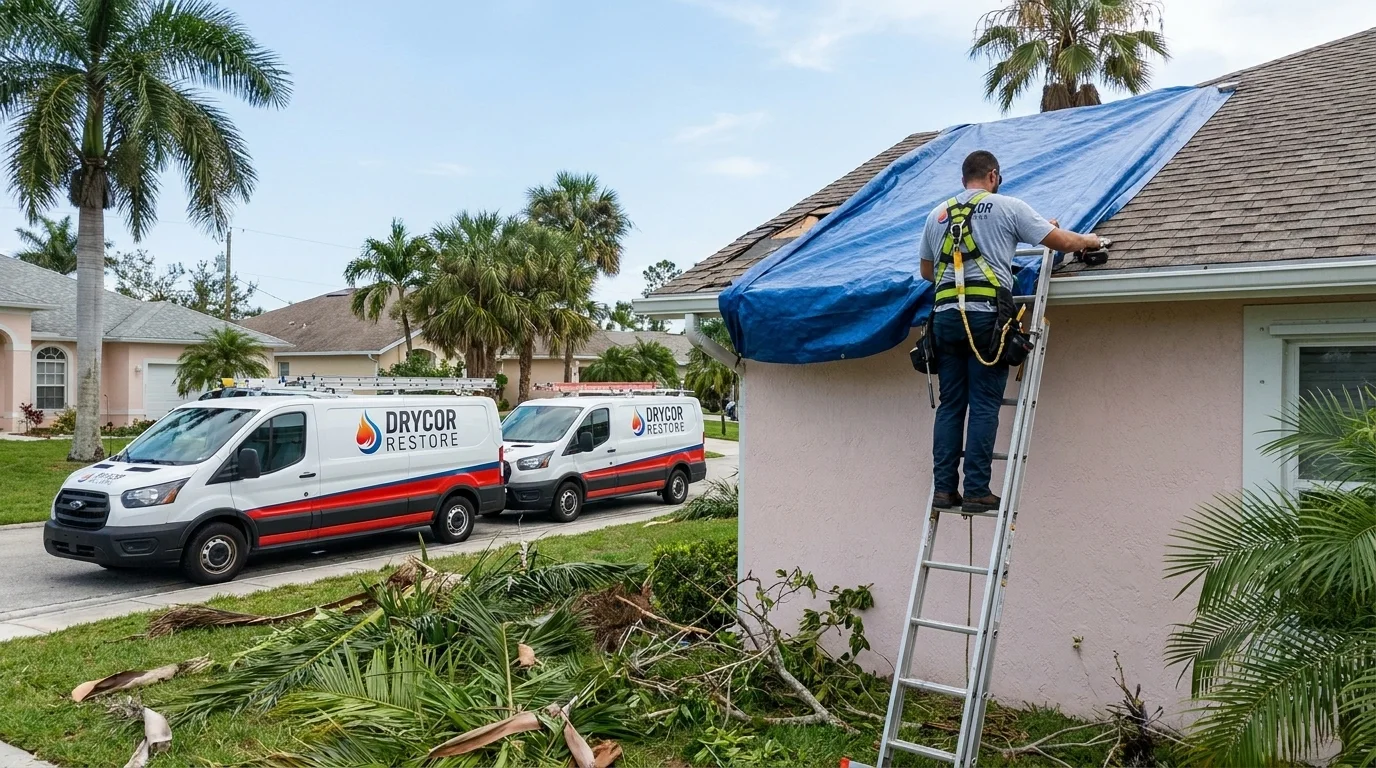
24/7 Emergency Storm Damage Restoration in Panama City
24/7 emergency storm damage restoration in Panama City, FL. IICRC-certified, insurance billing accepted. Call (813) 829-1091.
Our IICRC-certified technicians are dispatched from our Tampa Bay headquarters and are typically on-site in Panama City within 60 minutes of your call.
Storm damage emergency in Panama City? DRYCOR RESTORE answers 24/7 for wind, rain, and tree-impact damage across Bay County. Panama City sits on the Gulf Coast where hurricane season runs June through November, and a storm tracking through St. Andrew Bay can bring straight-line winds, torrential rain, and storm surge within the same afternoon. Call (813) 829-1091 the moment it’s safe to assess the property, roof damage, downed trees, and wind-driven water intrusion only get more expensive the longer they sit.
Why Panama City Properties See Storm Damage
The Florida Panhandle takes a direct hit from tropical systems more often than most of the state, and Panama City’s position on the Gulf puts it squarely in the path of storm surge pushing up St. Andrew Bay as well as the wind field that follows landfall. Mature pine trees common throughout Bay County are notorious for snapping or uprooting in sustained winds, and a single downed pine can punch through a roof deck, crack a slab foundation, or take down a fence line in seconds. Homes built before the Florida Building Code’s post-2004 wind mitigation updates are especially vulnerable, older roof-to-wall connections and original soffit systems don’t hold up the way newer construction does. Add in sandy coastal soil that drains fast on the surface but keeps crawlspaces and low-lying yards saturated for days, and you get a pattern we see constantly: wind damage up top, standing water down low, sometimes in the same house.
Our Storm Damage Restoration Process in Panama City
We start with a structural walk-through to flag immediate hazards, compromised roof sections, exposed electrical, standing water, before any interior work begins. Emergency board-up and tarping come first if the envelope is breached; a tarped roof or boarded window stops secondary damage while repairs are scheduled, and it matters here because Gulf Coast humidity means an open roof can wick moisture into insulation and drywall within hours, not days. From there we extract standing water, document every affected material for the claim, and begin structural drying following IICRC S500 guidelines. Tree removal and debris clearing are coordinated alongside drying so crews aren’t tripping over downed limbs or fence sections while they work. Once the structure is dry and stable, we move into reconstruction, replacing roof decking, drywall, flooring, or framing as needed, so the property comes back as one job instead of a string of separate contractors.
Reaching Panama City from Thonotosassa
We stage out of our Tampa Bay base and route crews west along the Panhandle corridor to reach Bay County properties. Storm response isn’t a single truck showing up, it’s board-up crews, extraction equipment, and a reconstruction team arriving in sequence, and we plan that sequence before we’re on the road so nothing sits waiting once we get there. Because storms often knock out power and block roads with downed trees, we coordinate alternate routes in advance when a named storm is approaching the area, rather than figuring it out after the fact.
Panama City Insurance Coordination
Most storm claims in this area involve wind damage, water intrusion, or both, and carriers increasingly want clear documentation separating the two since policies often treat them differently. We photograph and log damage by cause, roof uplift versus wind-driven rain versus surge flooding, so the claim isn’t contested over which peril caused what. For rebuilds, permitting typically runs through Bay County or the City of Panama City depending on the property’s location, and we factor that into the repair timeline so homeowners aren’t caught off guard by inspection scheduling.
Local note
One thing property owners don’t always expect: a Panama City roof that looks fine from the street can still have wind-lifted shingles or a cracked underlayment seam near the ridge, the kind of damage that doesn’t leak until the next heavy rain weeks later. We check ridge lines and flashing closely on any post-storm inspection here, even when the homeowner’s main concern is the fallen tree in the yard, because the tree is obvious and the slow roof leak isn’t.
If a recent storm left your Panama City property with roof damage, downed trees, or water intrusion, don’t wait for the next rain to find out how bad it is. DRYCOR RESTORE is licensed (#CBC1253966) and available around the clock to assess the damage, secure the structure, and get the restoration process moving. Call (813) 829-1091 for storm damage restoration in Panama City.
Serving Panama City from our Tampa Bay headquarters — ★ 4.9 on Google
“Working with said company was a great experience. Very professional and timely. I would absolutely recommend this company for any type of construction work.” — Michael, October 2026Read our reviews on Google →
Storm Damage Restoration in Panama City: Service Coverage
Frequently Asked Questions
How fast can you arrive for storm damage restoration in Panama City?
How quickly can DRYCOR RESTORE respond to storm damage in Panama City after a hurricane or severe thunderstorm?
Does Panama City's building code affect how storm repairs get rebuilt?
Are older Panama City homes more vulnerable to wind and tree damage than newer construction?
What's the process for drying out a Panama City home after storm surge or wind-driven rain gets inside?
Will my insurance cover both wind damage and water damage from the same Panama City storm?
Storm Damage Restoration response in Panama City
Most Panama City calls see a technician on-site within 60 minutes from our Tampa Bay headquarters.
Nearby & Related
- 24/7 Emergency Storm Damage Restoration in Tampa Bay
- Restoration Services in Panama City
- 24/7 Emergency Fire Damage Restoration in Panama City
- Mold Remediation in Panama City
- 24/7 Emergency Storm Damage Restoration in Anna Maria
- 24/7 Emergency Storm Damage Restoration in Apollo Beach
- Contact DRYCOR RESTORE