
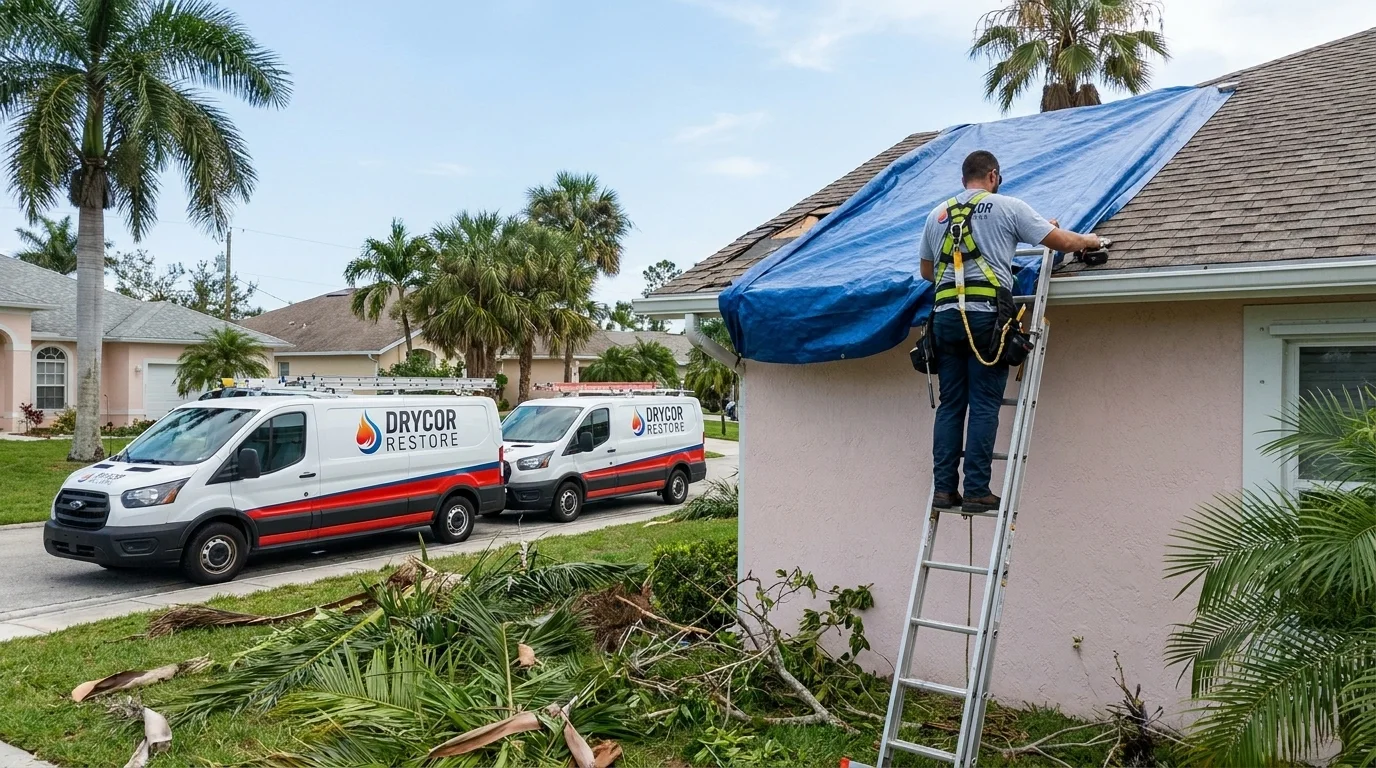
Storm Damage Restoration in Longboat Key
24/7 storm damage restoration in Longboat Key, FL. IICRC-certified, insurance billing accepted. Call (813) 829-1091.
Our IICRC-certified technicians are dispatched from our Thonotosassa, FL headquarters and are typically on-site in Longboat Key within 60 minutes of your call.
Longboat Key sits on a narrow barrier island between Sarasota Bay and the Gulf of Mexico, which means every named storm and severe weather event hits from multiple directions at once. Wind-driven rain finds its way under roof tiles, through aging window seals, and into the concrete block construction that defines much of the island’s mid-century housing stock. When a storm moves through, the damage is rarely just cosmetic. DRYCOR RESTORE responds 24/7 to storm damage calls on Longboat Key, working to stop secondary damage before the subtropical humidity turns a structural problem into a mold problem.
Why Longboat Key Properties Face Distinct Storm Damage Challenges
Barrier island geography concentrates storm risk in ways that mainland Sarasota County properties simply do not experience. Storm surge can push water inland from both the Gulf and the bay side simultaneously, leaving low-lying lots with standing water that has nowhere to drain quickly. The island’s sandy soil drains reasonably well under normal conditions, but a sustained tropical system overwhelms it, and water backs up against foundations and into garages.
The housing stock adds another layer of complexity. A large share of Longboat Key’s residential and condominium buildings date from the 1960s through the 1980s. Concrete block construction from that era is durable, but the original stucco coatings and window glazing were not designed to meet current Florida Building Code wind-load standards. Hurricane-force gusts can breach those older envelope details and introduce water into wall cavities that are difficult to access and slow to dry. Flat or low-slope roofing common on mid-century Gulf-front properties is particularly vulnerable to ponding after a storm strips or displaces roofing membrane.
Our Storm Damage Restoration Process on Longboat Key
The first priority after a storm is stopping ongoing intrusion. That means emergency tarping of compromised roof sections, boarding damaged windows and doors, and extracting any standing water before it migrates into wall assemblies or under tile flooring. Longboat Key’s high ambient humidity means that even a small amount of trapped moisture can support mold colonization within 24 to 48 hours of a weather event, so drying timelines here are tighter than in drier climates.
Once the structure is stabilized, the process moves to systematic moisture mapping. Our IICRC-certified technicians use thermal imaging and calibrated moisture meters to locate water that has wicked behind stucco, under slab tile, or into the concrete block itself. Drying equipment is positioned based on that mapping, not on a generic layout, because the dense wall assemblies common on the island require directed airflow to be effective. Structural repairs, debris removal, and coordination with roofing and glass subcontractors follow once drying readings confirm the structure is within acceptable limits.
Reaching Longboat Key from Thonotosassa
DRYCOR RESTORE operates 24/7, and our team routes to Longboat Key via I-75 south to the Sarasota metro, then west across the Ringling Causeway or the Longboat Key bridges depending on traffic and which end of the island the call is coming from. The island’s single north-south corridor, Gulf of Mexico Drive, means access during a major storm event can be complicated by debris, emergency closures, or bridge restrictions. We account for that when dispatching and communicate arrival windows honestly rather than promising a number that storm conditions could make impossible.
Longboat Key Insurance and HOA Coordination
Many Longboat Key properties, particularly the condominium towers and planned communities that line the Gulf side, are governed by HOA or condominium association documents that specify approved contractors, required documentation, and sometimes mandatory inspection steps before restoration work can begin or walls can be closed. We are familiar with that layer of coordination and carry the documentation that associations typically require, including our contractor license (#CBC1253966) and proof of insurance.
On the insurance side, storm damage claims in coastal Florida often involve wind versus water coverage disputes, particularly when surge and rain damage occur together. We document the loss thoroughly from the first site visit, photographing affected materials, recording moisture readings, and preparing scope documentation in formats that work with most major carriers’ adjuster workflows.
Local Note
One detail that catches property owners off guard on Longboat Key: the island’s condominium associations often have master insurance policies that cover the building envelope but not interior finishes or personal property, and the boundary between what the association’s policy covers and what the unit owner’s policy covers is rarely obvious from the damage itself. After a storm that breaches the roof or exterior walls, it is worth getting clarity on that boundary before restoration scoping begins, because it affects which carrier gets billed for which line items. We have navigated that documentation split on coastal condominium properties and can help you understand what information your adjuster will need from the site assessment.
If your Longboat Key property has taken storm damage, call DRYCOR RESTORE at (813) 829-1091. We are available around the clock, and we will give you a straight answer about what the damage involves and what it will take to fix it.
Serving Longboat Key from our Thonotosassa headquarters — ★ 5.0 · 23 Google reviews
“We have been working on our mold problem in our home for about a week with them and we are so grateful that we didn’t go with another “cheaper” company (it’s only cheaper because they aren’t doing the work right). If you are beginning your mold remediation experience you’ll learn quickly that a lot…” — Cora, July 2026Read our reviews on Google →
Storm Damage Restoration in Longboat Key: Service Coverage
Frequently Asked Questions
How fast can you arrive for storm damage restoration in Longboat Key?
How quickly can DRYCOR RESTORE reach a storm-damaged property on Longboat Key?
Does Longboat Key's barrier island location change how storm drying works compared to inland properties?
How does Longboat Key's condominium HOA structure affect storm damage restoration work?
What storm damage problems are most common in Longboat Key's mid-century concrete block homes?
Can storm surge and wind damage be covered under the same insurance claim on Longboat Key?
Storm Damage Restoration response in Longboat Key
Most Longboat Key calls see a technician on-site within 60 minutes from our Thonotosassa headquarters.