
Sewage Cleanup and Sanitization in Clearwater Beach
24/7 sewage cleanup and sanitization in Clearwater Beach, FL. IICRC-certified, insurance billing accepted. Call (813) 829-1091.
Our IICRC-certified technicians are dispatched from our Thonotosassa, FL headquarters and are typically on-site in Clearwater Beach within 60 minutes of your call.
Clearwater Beach sits on a narrow barrier island where the water table is never far below the surface and aging sewer infrastructure runs beneath streets that flood regularly during Gulf storm surges. When a sewer line backs up or a septic system overflows here, the contamination spreads faster than it would on higher, drier ground. Raw sewage carries Category 3 water, the most hazardous classification, and on a barrier island where humidity rarely drops and drainage is limited, that contamination can saturate subfloor materials and wall cavities within hours. DRYCOR RESTORE responds 24/7 to sewage backup emergencies throughout Clearwater Beach.
Why Clearwater Beach Properties Face Elevated Sewage Backup Risk
The barrier island geography that makes Clearwater Beach one of Florida’s most desirable coastal communities also creates real plumbing vulnerabilities. Pinellas County’s sewer mains run beneath streets that experience repeated saltwater intrusion and tidal pressure, and that constant exposure corrodes older clay and cast-iron lateral lines. Many of the mid-century cottages and low-rise condominiums that line the island were built in the 1950s and 1960s with plumbing that has never been fully replaced. When a lateral line cracks or root intrusion closes off flow, wastewater has nowhere to go but back through floor drains, toilets, and tub drains.
The island’s shallow water table compounds the problem. Unlike inland Pinellas County where soil can absorb some of the pressure during heavy rain, Clearwater Beach sits on a thin strip of sand where groundwater rises quickly. A heavy storm event can simultaneously surcharge the municipal sewer system and push groundwater up through foundation cracks, delivering contaminated water from two directions at once. Properties near the marina district and along the Gulf-side streets see this pattern more often than homeowners expect.
Our Sewage Cleanup and Sanitization Process in Clearwater Beach
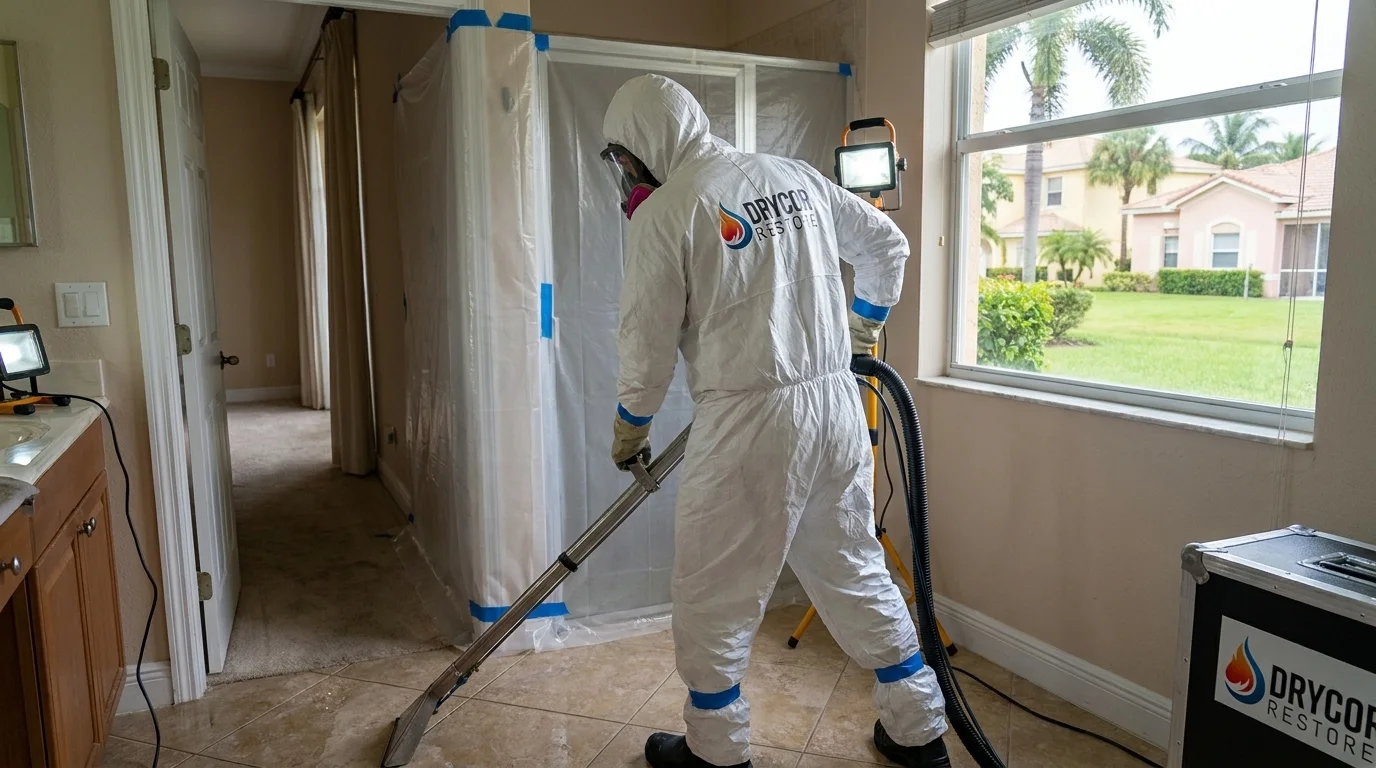
Raw sewage removal on a barrier island requires a containment-first approach. The moment a DRYCOR RESTORE crew arrives, the priority is stopping the spread of contaminated water before any extraction begins. On Clearwater Beach properties, that often means sealing off floor drains and assessing whether the backup has reached the crawl space or the slab edge, both common pathways in the island’s slab-on-grade construction.
Extraction uses truck-mounted and portable units calibrated for the volume of Category 3 water present. After bulk removal, every affected surface is treated with EPA-registered disinfectants formulated for biological contamination. Porous materials including drywall, insulation, and flooring that have absorbed sewage cannot be dried and reused; they are removed, bagged, and disposed of per Florida Department of Health guidelines. Structural cavities are then dried using commercial dehumidifiers and air movers, with moisture readings logged throughout the process to document that materials have reached target dryness levels before any reconstruction begins.
Reaching Clearwater Beach from Thonotosassa
DRYCOR RESTORE’s headquarters in Thonotosassa puts crews on SR-60 West as the primary route to Clearwater Beach, crossing the Courtney Campbell Causeway into Clearwater and then continuing west across the Memorial Causeway onto the island. The route is direct, and because DRYCOR RESTORE operates 24/7, crews can move during off-peak hours when the causeway is clear. For properties on the northern end of the island near the Sand Key corridor, the Belleair Causeway provides an alternate approach that avoids downtown Clearwater traffic during peak beach season.
Clearwater Beach Insurance Coordination
Sewage backup claims in Florida often hinge on whether the homeowner carries a separate sewer backup endorsement, which is not included in a standard HO-3 policy. DRYCOR RESTORE documents the loss thoroughly from the moment work begins: photographs of affected materials before removal, moisture readings at each measurement point, and a written scope of work that matches the line-item format most carriers require. That documentation matters especially in Clearwater Beach, where condominium associations and their master policies add a layer of coordination between the unit owner’s insurer and the HOA’s coverage.
Local Note
On Clearwater Beach, the combination of salt air and humidity means that even after sewage water is extracted and surfaces are disinfected, residual moisture in wall cavities can support mold colonization within 24 to 48 hours. The island’s warm baseline temperatures accelerate that timeline compared to inland areas. Properties in the older low-rise buildings along the Gulf-facing blocks tend to have original stucco exteriors that trap moisture at the wall assembly rather than releasing it outward, which means interior drying equipment needs to run longer than the surface readings alone suggest. Experienced crews account for this and don’t close out the drying phase based on surface moisture alone.
If you are dealing with a sewage backup or septic overflow anywhere in Clearwater Beach, call DRYCOR RESTORE at (813) 829-1091. Crews are available around the clock, and the documentation process starts the moment work begins so your claim has what it needs from day one.
Serving Clearwater Beach from our Thonotosassa headquarters — ★ 5.0 · 23 Google reviews
“We have been working on our mold problem in our home for about a week with them and we are so grateful that we didn’t go with another “cheaper” company (it’s only cheaper because they aren’t doing the work right). If you are beginning your mold remediation experience you’ll learn quickly that a lot…” — Cora, July 2026Read our reviews on Google →
Sewage Cleanup and Sanitization in Clearwater Beach: Service Coverage
Frequently Asked Questions
How fast can you arrive for sewage cleanup and sanitization in Clearwater Beach?
How does Clearwater Beach's barrier island geography affect how quickly sewage contamination spreads through a property?
Are the mid-century condominiums and cottages on Clearwater Beach more vulnerable to sewer line backups?
Does the Pinellas County sewer system surcharging during storms increase backup risk for Clearwater Beach properties?
What materials typically have to be removed after a sewage backup in a Clearwater Beach home?
How does the insurance claim process work for sewage backup damage in a Clearwater Beach condominium?
Sewage Cleanup and Sanitization response in Clearwater Beach
Most Clearwater Beach calls see a technician on-site within 60 minutes from our Thonotosassa headquarters.